Ch. 21 - Amino Acids, Peptides, and Proteins
Bruice - Organic Chemistry 8th Edition
Bruice8th EditionOrganic ChemistryISBN: 9780135213711Not the one you use?Change textbook
Chapter 22, Problem 37

Write the mechanism for the reaction of a cysteine side chain with iodoacetic acid.

Verified step by step guidance
1
Step 1: Identify the reactive groups in the cysteine side chain and iodoacetic acid. The cysteine side chain contains a thiol (-SH) group, which is nucleophilic. Iodoacetic acid contains an electrophilic carbon attached to iodine, making it susceptible to nucleophilic attack.
Step 2: The thiol group of cysteine performs a nucleophilic attack on the electrophilic carbon of iodoacetic acid. This occurs as the sulfur atom donates a pair of electrons to the carbon, displacing the iodine atom as a leaving group.
Step 3: The displacement of iodine results in the formation of a thioether bond between the sulfur atom of cysteine and the carbon of iodoacetic acid. This is a substitution reaction (SN2 mechanism).
Step 4: The product formed is a modified cysteine residue where the thiol group is now alkylated with the carboxymethyl group from iodoacetic acid. This modification is often used in biochemistry to block the thiol group or to introduce a functional group.
Step 5: Ensure the reaction conditions are suitable for the mechanism to proceed, such as maintaining a neutral or slightly basic pH to keep the thiol group deprotonated and nucleophilic.

Verified video answer for a similar problem:

This video solution was recommended by our tutors as helpful for the problem above.
Video duration:
3m
Was this helpful?

Key Concepts

Here are the essential concepts you must grasp in order to answer the question correctly.

Cysteine Structure and Reactivity

Cysteine is an amino acid containing a thiol (-SH) group in its side chain, which makes it nucleophilic. This thiol group can participate in various chemical reactions, including nucleophilic substitutions. Understanding the structure of cysteine is crucial for predicting its reactivity with electrophiles like iodoacetic acid.
Recommended video:
Guided course
01:49
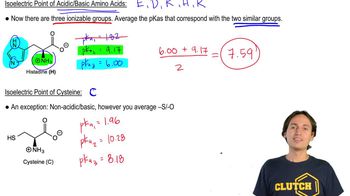
Isoelectric Point of Cysteine

Nucleophilic Substitution Mechanism (SN2)

The SN2 mechanism involves a nucleophile attacking an electrophile, resulting in the simultaneous displacement of a leaving group. In this case, the thiol group of cysteine acts as the nucleophile, attacking the carbon atom of iodoacetic acid that is bonded to iodine, leading to the formation of a thioester. This mechanism is characterized by a single concerted step and is essential for understanding the reaction pathway.
Recommended video:
Guided course
01:47
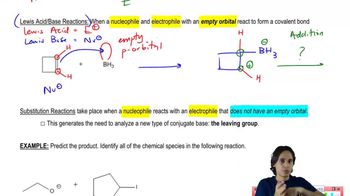
Nucleophiles and Electrophiles can react in Substitution Reactions.

Electrophiles and Leaving Groups

Electrophiles are species that accept electron pairs from nucleophiles during chemical reactions. In this reaction, iodoacetic acid serves as the electrophile, with the iodine atom acting as a good leaving group due to its ability to stabilize the negative charge after departure. Recognizing the roles of electrophiles and leaving groups is vital for analyzing reaction mechanisms in organic chemistry.
Recommended video:
Guided course
07:22
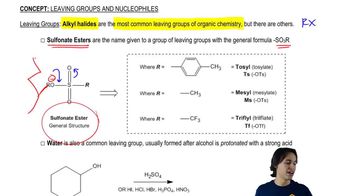
The 3 important leaving groups to know.