Ch. 21 - Amino Acids, Peptides, and Proteins
Bruice - Organic Chemistry 8th Edition
Bruice8th EditionOrganic ChemistryISBN: 9780135213711Not the one you use?Change textbook
Chapter 22, Problem 29

An opioid pentapeptide has the following structure: Tyr-Cys-Gly-Phe-Cys
a. Draw the structure of the pentapeptide including all the side chains.
b. Write its structure following mild oxidation.

Verified step by step guidance
1
Step 1: Begin by understanding the structure of the pentapeptide. A pentapeptide consists of five amino acids linked by peptide bonds. In this case, the sequence is Tyr (Tyrosine), Cys (Cysteine), Gly (Glycine), Phe (Phenylalanine), and Cys (Cysteine). Each amino acid has a unique side chain that must be included in the structure.
Step 2: Draw the backbone of the pentapeptide. The backbone consists of alternating nitrogen and carbon atoms connected by peptide bonds. Use the general formula for a peptide bond: H-N-CH(R)-C(O)-, where R represents the side chain of each amino acid.
Step 3: Add the side chains for each amino acid. Tyrosine has a phenol group (OH attached to a benzene ring), Cysteine has a thiol group (SH), Glycine has a hydrogen atom as its side chain, and Phenylalanine has a benzyl group (CH(CH2)-C(H)-C(H)-C(H)).
Step 4: For part b, consider the mild oxidation of the pentapeptide. Mild oxidation typically affects the thiol groups of cysteine residues. Two cysteine residues can form a disulfide bond (S-S) through oxidation. Update the structure to reflect the formation of this disulfide bond between the two cysteine residues.
Step 5: Verify the final structure. Ensure that all peptide bonds are correctly drawn, side chains are accurately represented, and the disulfide bond is included in the oxidized structure. This will give you the complete structure of the pentapeptide before and after mild oxidation.

Verified video answer for a similar problem:

This video solution was recommended by our tutors as helpful for the problem above.
Was this helpful?

Key Concepts

Here are the essential concepts you must grasp in order to answer the question correctly.

Peptide Structure

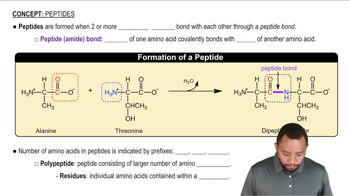
Peptides are short chains of amino acids linked by peptide bonds, formed through a condensation reaction between the carboxyl group of one amino acid and the amino group of another. The sequence and composition of amino acids determine the peptide's properties and functions. In this case, the pentapeptide Tyr-Cys-Gly-Phe-Cys consists of five specific amino acids, each contributing unique side chains that affect the overall structure.
Recommended video:
3:07
Peptides Concept 1

Amino Acid Side Chains

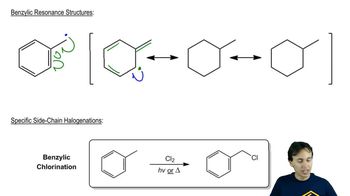
Each amino acid has a distinct side chain (R group) that influences its chemical behavior and interactions. For example, tyrosine (Tyr) has a hydroxyl group, cysteine (Cys) contains a thiol group, glycine (Gly) is the simplest amino acid with a hydrogen side chain, and phenylalanine (Phe) has a hydrophobic aromatic side chain. Understanding these side chains is crucial for drawing the correct structure of the pentapeptide and predicting its reactivity.
Recommended video:
Guided course
06:14
Side-Chain Halogenations

Oxidation of Cysteine Residues

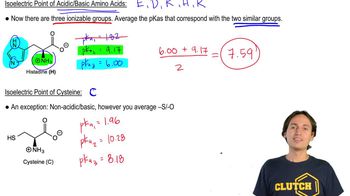
Cysteine residues can undergo oxidation, leading to the formation of disulfide bonds (–S–S–) between two cysteine side chains. This reaction is significant in stabilizing the three-dimensional structure of peptides and proteins. In the context of the pentapeptide, mild oxidation would convert the two cysteine residues into a disulfide bond, altering the peptide's structure and potentially its biological activity.
Recommended video:
Guided course
01:49
Isoelectric Point of Cysteine