Ch. 2 - Acids and Bases: Central to Understanding Organic Chemistry
Bruice - Organic Chemistry 8th Edition
Bruice8th EditionOrganic ChemistryISBN: 9780135213711Not the one you use?Change textbook
Chapter 3, Problem 39i

For each of the following compounds (here shown in their acidic forms), write the form that ­predominates in a solution with a pH = 5.5:
i. HON+H3 (pKa = 6.0)

Verified step by step guidance
1
Step 1: Understand the problem. The goal is to determine the predominant form of the compound HON+H3 in a solution with a pH of 5.5. This involves comparing the pH of the solution to the pKa of the compound to assess whether it exists primarily in its acidic or basic form.
Step 2: Recall the relationship between pH and pKa. The Henderson-Hasselbalch equation is key here: pH=pKa+log([A^-][HA]). When pH is much higher than pKa, the compound exists predominantly in its deprotonated (basic) form. When pH is much lower than pKa, the compound exists predominantly in its protonated (acidic) form.
Step 3: Compare the pH of the solution (5.5) to the pKa of HON+H3 (−6.0). Since the pH is significantly higher than the pKa, this indicates that the compound will predominantly exist in its deprotonated form.
Step 4: Write the deprotonated form of HON+H3. Deprotonation involves the removal of a proton (H+). The resulting form will be HONH2, as the positively charged proton is removed.
Step 5: Confirm the reasoning. The large difference between the pH and pKa ensures that the equilibrium strongly favors the deprotonated form (HONH2) in a solution with a pH of 5.5.

Verified video answer for a similar problem:

This video solution was recommended by our tutors as helpful for the problem above.
Video duration:
3m
Was this helpful?

Key Concepts

Here are the essential concepts you must grasp in order to answer the question correctly.

pH and pKa Relationship

The pH of a solution indicates its acidity or basicity, with lower values being more acidic. The pKa is a measure of the strength of an acid; it is the pH at which half of the acid is dissociated. When pH is lower than pKa, the protonated form predominates, while at higher pH, the deprotonated form is favored. Understanding this relationship is crucial for predicting the predominant form of an acid in solution.
Recommended video:
Guided course
07:45
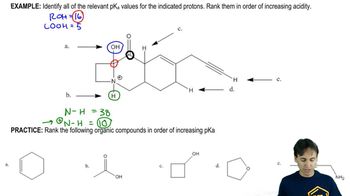
Identifying pKa values

Acid-Base Equilibrium

Acid-base equilibrium describes the balance between an acid and its conjugate base in solution. The equilibrium can shift depending on the pH of the solution, which affects the concentration of protonated and deprotonated species. For a given acid, if the pH is above its pKa, the deprotonated form is favored, while if it is below, the protonated form predominates. This concept is essential for determining the predominant species at a specific pH.
Recommended video:
Guided course
04:00
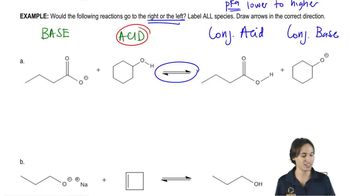
Determining Acid/Base Equilibrium

Strong vs. Weak Acids

Strong acids completely dissociate in solution, while weak acids only partially dissociate. The given compound, HON+H3, has a very low pKa of -6.0, indicating it is a strong acid. In a solution with a pH of 5.5, which is much higher than the pKa, the strong acid will predominantly exist in its protonated form, as it remains largely dissociated even at higher pH levels. Recognizing the strength of the acid is vital for predicting its behavior in solution.
Recommended video:
Guided course
04:15
Monosaccharides - Weak Oxidation (Aldonic Acid)