Ch. 2 - Acids and Bases: Central to Understanding Organic Chemistry
Bruice - Organic Chemistry 8th Edition
Bruice8th EditionOrganic ChemistryISBN: 9780135213711Not the one you use?Change textbook
Chapter 3, Problem 42b(1,2,3)

Indicate whether an alcohol (ROH) with a pKa value of 15 has more charged or more neutral molecules in a solution with the pH values given in Problem 41.
1. pH = 1
2. pH = 3
3. pH = 5

Verified step by step guidance
1
Step 1: Recall the relationship between pKa, pH, and the ratio of charged to neutral species. The Henderson-Hasselbalch equation is used to determine the ratio of the conjugate base (charged form, RO⁻) to the neutral form (ROH): \( \text{pH} = \text{pKa} + \log \left( \frac{[\text{RO}^-]}{[\text{ROH}]} \right) \).
Step 2: Rearrange the Henderson-Hasselbalch equation to solve for the ratio \( \frac{[\text{RO}^-]}{[\text{ROH}]} \): \( \frac{[\text{RO}^-]}{[\text{ROH}]} = 10^{\text{pH} - \text{pKa}} \).
Step 3: For each pH value (12, 33, and 5), calculate \( \text{pH} - \text{pKa} \) to determine whether the solution favors the charged form (RO⁻) or the neutral form (ROH). If \( \text{pH} > \text{pKa} \), the charged form (RO⁻) predominates. If \( \text{pH} < \text{pKa} \), the neutral form (ROH) predominates.
Step 4: For pH = 12, calculate \( \text{pH} - \text{pKa} = 12 - 15 = -3 \). Since \( \text{pH} < \text{pKa} \), the neutral form (ROH) predominates in this case.
Step 5: Repeat the process for pH = 33 and pH = 5. For pH = 33, \( \text{pH} - \text{pKa} = 33 - 15 = 18 \), so the charged form (RO⁻) predominates. For pH = 5, \( \text{pH} - \text{pKa} = 5 - 15 = -10 \), so the neutral form (ROH) predominates.

Verified video answer for a similar problem:

This video solution was recommended by our tutors as helpful for the problem above.
Video duration:
4m
Was this helpful?

Key Concepts

Here are the essential concepts you must grasp in order to answer the question correctly.

pKa and pH Relationship

The pKa value of a compound indicates the acidity of that compound, with lower pKa values corresponding to stronger acids. In a solution, the pH reflects the concentration of hydrogen ions (H+). When the pH is lower than the pKa, the compound is more likely to be protonated (charged), while at a higher pH, it tends to be deprotonated (neutral). Understanding this relationship is crucial for predicting the charge state of alcohols in different pH environments.
Recommended video:
Guided course
07:45
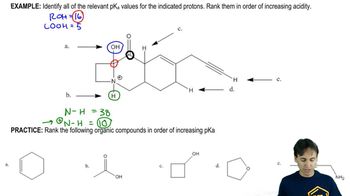
Identifying pKa values

Protonation and Deprotonation

Protonation refers to the addition of a proton (H+) to a molecule, which can change its charge state. For alcohols, the hydroxyl group (–OH) can be protonated to form an oxonium ion (–OH2+), making it positively charged. Conversely, deprotonation occurs when a proton is removed, resulting in a neutral molecule. The balance between these processes is influenced by the solution's pH relative to the compound's pKa.
Recommended video:
Guided course
03:
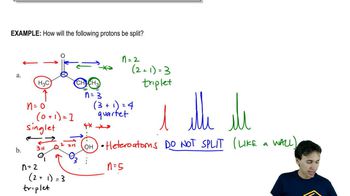
Proton Splitting

Charge Distribution in Solutions

In a solution, the distribution of charged versus neutral molecules depends on the pH relative to the pKa of the solute. For an alcohol with a pKa of 15, at very low pH (like 1 or 3), the majority of molecules will be protonated and thus charged. As the pH increases towards 5, more molecules will be deprotonated, leading to a higher proportion of neutral molecules. This concept is essential for predicting the behavior of alcohols in various pH conditions.
Recommended video:
Guided course
01:34
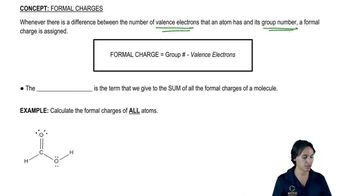
Calculating formal and net charge.