Ch. 2 - Acids and Bases: Central to Understanding Organic Chemistry
Bruice - Organic Chemistry 8th Edition
Bruice8th EditionOrganic ChemistryISBN: 9780135213711Not the one you use?Change textbook
Chapter 3, Problem 39c,d

For each of the following compounds (here shown in their acidic forms), write the form that ­predominates in a solution with a pH = 5.5:
c. H3O+ (pKa = −1.7)
d. HBr (pKa = −9)

Verified step by step guidance
1
Step 1: Understand the problem. You are tasked with determining the predominant form of the given compounds in a solution with a pH of 5.5. This involves comparing the pH of the solution to the pKa of each compound to determine whether the compound exists primarily in its protonated (acidic) or deprotonated (basic) form.
Step 2: Recall the relationship between pH and pKa. The Henderson-Hasselbalch equation is useful here: pH=pKa+log([A⁻][HA]). When pH > pKa, the deprotonated form ([A⁻]) predominates. When pH < pKa, the protonated form ([HA]) predominates.
Step 3: Analyze compound (c) H₃O⁺ (pKa = -1.7). Compare the pH of the solution (5.5) to the pKa of H₃O⁺. Since pH (5.5) is much greater than pKa (-1.7), the deprotonated form of H₃O⁺, which is H₂O, will predominate in the solution.
Step 4: Analyze compound (d) HBr (pKa = -9). Compare the pH of the solution (5.5) to the pKa of HBr. Since pH (5.5) is much greater than pKa (-9), the deprotonated form of HBr, which is Br⁻, will predominate in the solution.
Step 5: Summarize the results. For H₃O⁺, the predominant form at pH 5.5 is H₂O. For HBr, the predominant form at pH 5.5 is Br⁻. This conclusion is based on the comparison of the solution's pH to the pKa values of the compounds.

Verified video answer for a similar problem:

This video solution was recommended by our tutors as helpful for the problem above.
Video duration:
2m
Was this helpful?

Key Concepts

Here are the essential concepts you must grasp in order to answer the question correctly.

pKa and Acid-Base Equilibrium

pKa is a measure of the strength of an acid in solution; it is the negative logarithm of the acid dissociation constant (Ka). A lower pKa value indicates a stronger acid that dissociates more completely in solution. Understanding the relationship between pKa and pH is crucial for predicting the predominant form of an acid in a given pH environment.
Recommended video:
Guided course
04:00
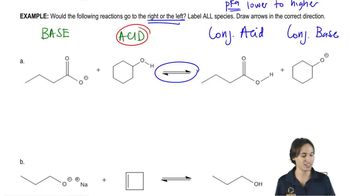
Determining Acid/Base Equilibrium

Henderson-Hasselbalch Equation

The Henderson-Hasselbalch equation relates pH, pKa, and the ratio of the concentrations of the deprotonated and protonated forms of an acid. It is expressed as pH = pKa + log([A-]/[HA]). This equation helps determine the predominant species in solution by comparing the pH to the pKa of the acid, allowing for the prediction of whether the protonated or deprotonated form is favored.
Recommended video:
Guided course
05:02
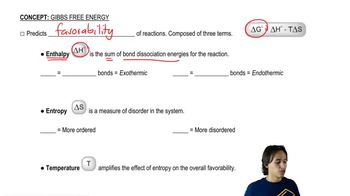
Breaking down the different terms of the Gibbs Free Energy equation.

Acid-Base Species in Solution

In an aqueous solution, acids can exist in protonated (HA) and deprotonated (A-) forms. The predominant species at a given pH depends on the acid's strength (indicated by pKa) and the solution's pH. For strong acids, such as HBr, the deprotonated form is negligible, while for weaker acids, the balance between the two forms shifts based on the pH relative to the pKa.
Recommended video:
Guided course
02:49
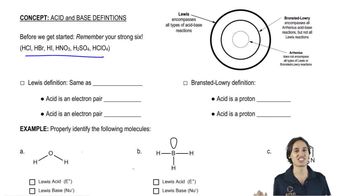
The Lewis definition of acids and bases.