Ch. 2 - Acids and Bases: Central to Understanding Organic Chemistry
Bruice - Organic Chemistry 8th Edition
Bruice8th EditionOrganic ChemistryISBN: 9780135213711Not the one you use?Change textbook
Chapter 3, Problem 13

a. Which is a stronger base: CH3COO or HCOO? (The pKa of CH3COOH is 4.8; the pKa of HCOOH is 3.8.)
b. Which is a stronger base: HO or -NH2? (The pKa of H2O is 15.7; the pKa of NH3 is 36.)
c. Which is a stronger base: H2O or CH3OH? (The pKa of H3O+ is −1.7; the pKa of CH3O+H2 is −2.5.)

Verified step by step guidance
1
Step 1: Understand the relationship between pKa and base strength. The strength of a base is inversely related to the strength of its conjugate acid. A lower pKa value of the conjugate acid indicates a stronger acid, and thus, a weaker conjugate base. Conversely, a higher pKa value of the conjugate acid indicates a weaker acid, and thus, a stronger conjugate base.
Step 2: For part (a), compare CH3COO− and HCOO−. The conjugate acids are CH3COOH (pKa = 4.8) and HCOOH (pKa = 3.8), respectively. Since CH3COOH has a higher pKa than HCOOH, it is a weaker acid. Therefore, CH3COO− is the stronger base compared to HCOO−.
Step 3: For part (b), compare HO− and -NH2. The conjugate acids are H2O (pKa = 15.7) and NH3 (pKa = 36), respectively. Since NH3 has a much higher pKa than H2O, it is a much weaker acid. Therefore, -NH2 is a significantly stronger base compared to HO−.
Step 4: For part (c), compare H2O and CH3OH. The conjugate acids are H3O+ (pKa = −1.7) and CH3O+H2 (pKa = −2.5), respectively. Since H3O+ has a higher pKa than CH3O+H2, it is a weaker acid. Therefore, H2O is the stronger base compared to CH3OH.
Step 5: Summarize the results: (a) CH3COO− is the stronger base, (b) -NH2 is the stronger base, and (c) H2O is the stronger base. This conclusion is based on the pKa values of the conjugate acids and the inverse relationship between acid strength and base strength.

Verified video answer for a similar problem:

This video solution was recommended by our tutors as helpful for the problem above.
Video duration:
5m
Was this helpful?

Key Concepts

Here are the essential concepts you must grasp in order to answer the question correctly.

Acid-Base Strength and pKa

The strength of an acid or base is often measured by its pKa value, which indicates the tendency of an acid to donate protons. A lower pKa value corresponds to a stronger acid, meaning it dissociates more readily in solution. Conversely, the strength of a base can be inferred from the pKa of its conjugate acid; a higher pKa of the conjugate acid indicates a stronger base.
Recommended video:
Guided course
07:45
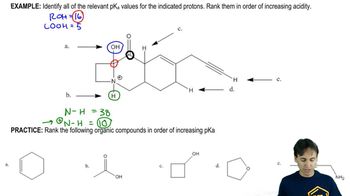
Identifying pKa values

Conjugate Acid-Base Pairs

In acid-base chemistry, every acid has a corresponding conjugate base, and vice versa. The relationship between an acid and its conjugate base is crucial for determining relative strengths. For example, if an acid has a low pKa, its conjugate base will be a stronger base. Understanding these pairs helps in comparing the basicity of different species.
Recommended video:
2:56
Base Pairing Concept 1

Comparative Basicity

To determine which of two bases is stronger, one can compare the pKa values of their conjugate acids. The base that corresponds to the acid with the higher pKa is the stronger base. This comparative approach is essential in evaluating the basicity of different species, as seen in the examples provided in the question.
Recommended video:
Guided course
06:21
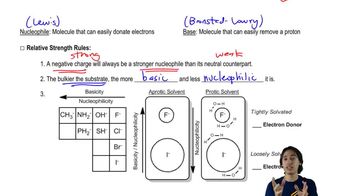
Understanding the difference between basicity and nucleophilicity.