Textbook Question
Does methanol behave as an acid or a base when it reacts with methylamine?
2
views

 Bruice 8th EditionCh. 2 - Acids and Bases: Central to Understanding Organic ChemistryProblem 16a(3,4)
 Verified step by step guidance
 04:00
04:00
 06:27
06:27 3:05
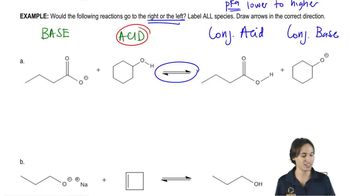
3:05Does methanol behave as an acid or a base when it reacts with methylamine?
For each of the acid–base reactions in [Section 2.3], compare the pKa values of the acids on either side of the equilibrium arrows to prove that the equilibrium lies in the direction indicated.
1. <IMAGE>
2. <IMAGE>
Ethyne (HC≡CH) has a pKa value of 25, water has a pKa value of 15.7, and ammonia (NH3) has a pKa value of 36. Draw the equation, showing equilibrium arrows that indicate whether reactants or products are favored, for the acid–base reaction of ethyne with
b. −NH2.
c. Which would be a better base to use if you wanted to remove a proton from ethyne, HO− or -NH2?
Ethyne (HC≡CH) has a pKa value of 25, water has a pKa value of 15.7, and ammonia (NH3) has a pKa value of 36. Draw the equation, showing equilibrium arrows that indicate whether reactants or products are favored, for the acid–base reaction of ethyne with
a. HO-.
a. Which is a stronger base: CH3COO− or HCOO−? (The pKa of CH3COOH is 4.8; the pKa of HCOOH is 3.8.)
b. Which is a stronger base: HO− or -NH2? (The pKa of H2O is 15.7; the pKa of NH3 is 36.)
c. Which is a stronger base: H2O or CH3OH? (The pKa of H3O+ is −1.7; the pKa of CH3O+H2 is −2.5.)
Which of the following bases can remove a proton from acetic acid in a reaction that favors products?
HO− CH3NH2 HC≡C− CH3OH H2O Cl−