Ch. 19 - More About Amines • Reactions of Heterocyclic Compounds
Bruice - Organic Chemistry 8th Edition
Bruice8th EditionOrganic ChemistryISBN: 9780135213711Not the one you use?Change textbook
Chapter 20, Problem 22g

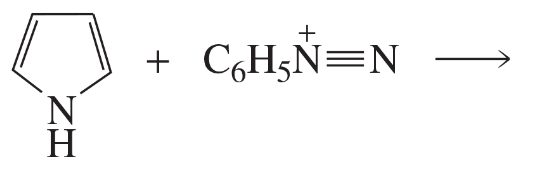
What are the products of the following reactions?
g.

Verified step by step guidance
1
Step 1: Identify the reactants. The first reactant is pyrrole, a five-membered aromatic ring containing nitrogen. The second reactant is a diazonium salt, specifically benzenediazonium ion (C₆H₅N⁺≡N).
Step 2: Recognize the type of reaction. This is an electrophilic substitution reaction where the diazonium ion acts as an electrophile and reacts with the pyrrole ring.
Step 3: Determine the site of attack. Pyrrole is highly reactive due to its aromaticity and electron-rich nature. The nitrogen atom contributes electron density to the ring, making the 2-position (adjacent to nitrogen) the most reactive site for electrophilic substitution.
Step 4: Predict the intermediate. The diazonium ion will attack the 2-position of pyrrole, forming a sigma complex (arenium ion) as an intermediate. This intermediate will then lose a proton to restore aromaticity.
Step 5: Write the product structure. The final product will be a 2-aryl pyrrole, where the phenyl group (C₆H₅) is attached to the 2-position of the pyrrole ring.

Verified video answer for a similar problem:

This video solution was recommended by our tutors as helpful for the problem above.
Video duration:
5m
Was this helpful?

Key Concepts

Here are the essential concepts you must grasp in order to answer the question correctly.

Reaction Mechanisms

Understanding reaction mechanisms is crucial in organic chemistry as they describe the step-by-step process by which reactants transform into products. This includes identifying intermediates, transition states, and the movement of electrons. A clear grasp of mechanisms helps predict the products of reactions and the conditions under which they occur.
Recommended video:
Guided course
02:16
Heck Reaction Mechanism

Functional Groups

Functional groups are specific groups of atoms within molecules that are responsible for the characteristic chemical reactions of those molecules. Recognizing functional groups allows chemists to predict reactivity and the types of products formed in a reaction. Common functional groups include alcohols, carboxylic acids, and amines, each influencing the behavior of the molecule.
Recommended video:
Guided course
02:36
Identifying Functional Groups

Stereochemistry

Stereochemistry involves the study of the spatial arrangement of atoms in molecules and how this affects their chemical behavior. It is essential for understanding isomerism, where compounds with the same molecular formula can have different structures and properties. Stereochemical considerations can significantly influence the products of reactions, especially in chiral environments.
Recommended video:
1:38
Polymer Stereochemistry Concept 1