Ch. 19 - More About Amines • Reactions of Heterocyclic Compounds
Bruice - Organic Chemistry 8th Edition
Bruice8th EditionOrganic ChemistryISBN: 9780135213711Not the one you use?Change textbook
Chapter 20, Problem 22b

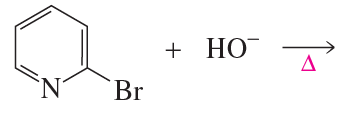
What are the products of the following reactions?
b. Chemical reaction diagram showing nucleophilic aromatic substitution with a brominated aromatic compound and hydroxide ion.

Verified step by step guidance
1
Step 1: Identify the type of reaction. The given reaction involves a chloropyridine compound reacting with hydroxide ion (HO⁻) under heat (Δ). This suggests a nucleophilic aromatic substitution (SNAr) mechanism, which is common for aromatic compounds with electron-withdrawing groups.
Step 2: Analyze the structure of the reactant. The pyridine ring contains a chlorine atom attached to the carbon adjacent to the nitrogen atom. The nitrogen atom in pyridine is electron-withdrawing, making the ring more susceptible to nucleophilic attack.
Step 3: Determine the site of nucleophilic attack. The hydroxide ion (HO⁻) will attack the carbon atom bonded to the chlorine atom, as chlorine is a good leaving group and the carbon is activated by the electron-withdrawing effect of the nitrogen atom.
Step 4: Describe the intermediate formed. After the hydroxide ion attacks, a negatively charged intermediate (Meisenheimer complex) is formed, where the aromaticity of the ring is temporarily lost. This intermediate will then eliminate the chlorine atom as Cl⁻, restoring aromaticity.
Step 5: Predict the final product. The chlorine atom is replaced by the hydroxyl group (-OH), resulting in the formation of 2-hydroxypyridine as the product of the reaction.

Verified video answer for a similar problem:

This video solution was recommended by our tutors as helpful for the problem above.
Video duration:
5m
Was this helpful?

Key Concepts

Here are the essential concepts you must grasp in order to answer the question correctly.

Nucleophilic Aromatic Substitution

Nucleophilic aromatic substitution (NAS) is a reaction where a nucleophile replaces a leaving group on an aromatic ring. This process typically occurs when the aromatic compound has electron-withdrawing groups, which stabilize the negative charge that forms during the reaction. In this case, the hydroxide ion (OH-) acts as the nucleophile, attacking the carbon atom bonded to the chlorine atom, leading to the substitution.
Recommended video:
Guided course
01:47
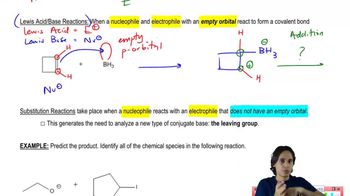
Nucleophiles and Electrophiles can react in Substitution Reactions.

Leaving Groups

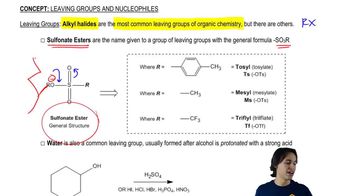
A leaving group is an atom or group that can depart from the parent molecule during a chemical reaction, allowing for the formation of a new bond. In nucleophilic aromatic substitution, good leaving groups, such as halides (e.g., Cl-), facilitate the reaction by stabilizing the transition state. The ability of a leaving group to depart is crucial for the success of the substitution reaction.
Recommended video:
Guided course
07:22
The 3 important leaving groups to know.

Resonance Stabilization

Resonance stabilization refers to the delocalization of electrons in a molecule, which can enhance its stability. In nucleophilic aromatic substitution, the formation of a Meisenheimer complex (an intermediate) allows for resonance structures that distribute the negative charge over the aromatic system. This stabilization is essential for the reaction to proceed, especially when the nucleophile attacks the aromatic ring.
Recommended video:
Guided course
03:43
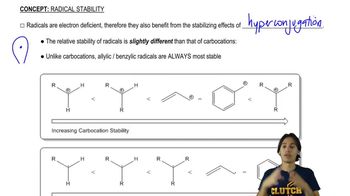
The radical stability trend.