Ch. 19 - More About Amines • Reactions of Heterocyclic Compounds
Bruice - Organic Chemistry 8th Edition
Bruice8th EditionOrganic ChemistryISBN: 9780135213711Not the one you use?Change textbook
Chapter 20, Problem 22i

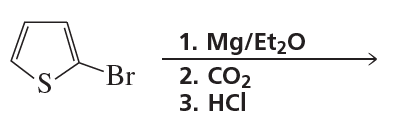
What are the products of the following reactions?
i. Chemical reaction diagram showing a compound with bromine and sulfur, followed by reagents and reaction steps.

Verified step by step guidance
1
Step 1: Analyze the starting material. The given compound is a brominated furan, specifically 2-bromofuran. The bromine atom is attached to the furan ring, which is an aromatic heterocyclic compound containing oxygen.
Step 2: Understand the first reaction step. The reaction involves magnesium (Mg) in diethyl ether (Et₂O), which is a common method to form a Grignard reagent. The bromine atom reacts with magnesium to form the Grignard reagent, 2-furylmagnesium bromide.
Step 3: Examine the second reaction step. The Grignard reagent reacts with carbon dioxide (CO₂). This step involves nucleophilic attack by the Grignard reagent on the electrophilic carbon atom of CO₂, leading to the formation of a carboxylate intermediate.
Step 4: Consider the third reaction step. The carboxylate intermediate is protonated by hydrochloric acid (HCl), resulting in the formation of the final product, which is a carboxylic acid. The carboxylic acid will retain the furan ring structure with the carboxyl group (-COOH) attached to the position where the bromine was originally located.
Step 5: Summarize the overall transformation. The reaction sequence converts 2-bromofuran into 2-furoic acid through the formation of a Grignard reagent, reaction with CO₂, and subsequent acid workup.

Verified video answer for a similar problem:

This video solution was recommended by our tutors as helpful for the problem above.
Video duration:
5m
Was this helpful?

Key Concepts

Here are the essential concepts you must grasp in order to answer the question correctly.

Grignard Reagents

Grignard reagents are organomagnesium compounds formed by the reaction of magnesium with alkyl or aryl halides. They are highly reactive and serve as nucleophiles in organic synthesis, allowing for the formation of carbon-carbon bonds. In this reaction, the brominated compound reacts with magnesium in ether to generate a Grignard reagent, which can then react with carbon dioxide.
Recommended video:
Guided course
02:12
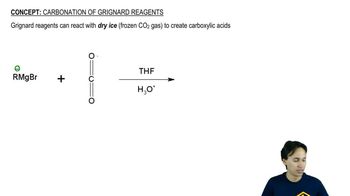
Carbonation of Grignard Reagents

Carboxylation

Carboxylation is a chemical reaction that introduces a carboxyl group (-COOH) into a molecule. In this case, the Grignard reagent reacts with carbon dioxide to form a carboxylic acid. This step is crucial for transforming the initial brominated compound into a more complex structure, ultimately leading to the formation of a carboxylic acid after subsequent acid workup.
Recommended video:
Guided course
04:20
Carboxylic Acids Nomenclature

Acid Workup

An acid workup is a common procedure in organic synthesis that involves adding an acid, such as hydrochloric acid (HCl), to neutralize a reaction mixture and protonate any basic species. In this reaction, the acid workup is necessary to convert the carboxylate salt formed from the carboxylation step into the corresponding carboxylic acid, which is the final product of the reaction.
Recommended video:
Guided course
01:31
Oxidative Workup Mechanism: