Ch. 18 - Reactions of Benzene and Substituted Benzenes
Bruice - Organic Chemistry 8th Edition
Bruice8th EditionOrganic ChemistryISBN: 9780135213711Not the one you use?Change textbook
Chapter 19, Problem 101e

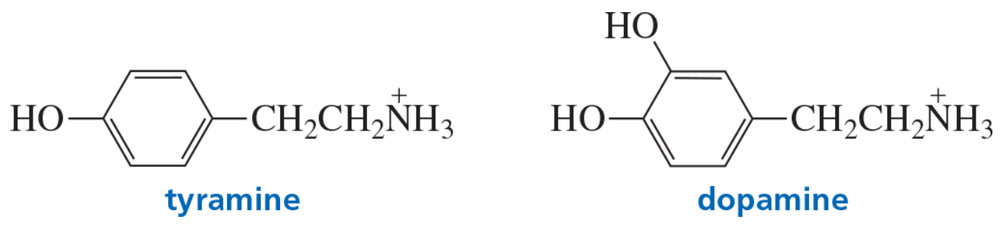
Tyramine is an alkaloid found in mistletoe and ripe cheese. Dopamine is a neurotransmitter involved in the regulation of the central nervous system.

e. How can b-phenylethylamine be prepared from benzaldehyde?

Verified step by step guidance
1
Step 1: Begin with benzaldehyde (C6H5CHO) as the starting material. Benzaldehyde contains a benzene ring with an aldehyde functional group (-CHO). The goal is to convert this aldehyde into β-phenylethylamine, which has an amine group (-NH2) attached to a two-carbon chain connected to the benzene ring.
Step 2: Perform a reductive amination reaction. First, convert benzaldehyde into phenylacetaldehyde (C6H5CH2CHO) by using a reagent such as ethylmagnesium bromide (Grignard reagent) followed by hydrolysis. This step introduces a methylene (-CH2-) group between the benzene ring and the aldehyde group.
Step 3: React phenylacetaldehyde with ammonia (NH3) or a primary amine in the presence of a reducing agent such as sodium cyanoborohydride (NaBH3CN) or hydrogen gas with a metal catalyst (e.g., Pd/C). This step replaces the aldehyde group (-CHO) with an amine group (-NH2), forming β-phenylethylamine.
Step 4: Purify the product using techniques such as recrystallization or distillation to isolate β-phenylethylamine. Ensure the reaction conditions are optimized to minimize side reactions and maximize yield.
Step 5: Confirm the structure of β-phenylethylamine using spectroscopic methods such as NMR (nuclear magnetic resonance) or IR (infrared spectroscopy) to verify the presence of the amine group and the two-carbon chain attached to the benzene ring.

Key Concepts

Here are the essential concepts you must grasp in order to answer the question correctly.

Aromatic Compounds

Aromatic compounds are cyclic structures that follow Huckel's rule, containing alternating double bonds and a planar configuration. They exhibit unique stability due to resonance, which allows for delocalization of electrons. Understanding aromaticity is crucial for predicting the reactivity and properties of compounds like tyramine and dopamine, which are both aromatic amines.
Recommended video:
Guided course
08:19
Intro to Aromaticity

Amines and Their Reactions

Amines are organic compounds derived from ammonia by replacing one or more hydrogen atoms with alkyl or aryl groups. They can act as nucleophiles in various reactions, including alkylation and acylation. The preparation of b-phenylethylamine from benzaldehyde involves the reduction of an intermediate, highlighting the importance of understanding amine chemistry in organic synthesis.
Recommended video:
Guided course
03:46
Buchwald-Hartwig Amination Reaction

Synthetic Pathways in Organic Chemistry

Synthetic pathways refer to the series of chemical reactions that transform starting materials into desired products. In the context of preparing b-phenylethylamine from benzaldehyde, one must consider the necessary reagents and reaction conditions, such as reduction methods. Familiarity with these pathways is essential for effective problem-solving in organic synthesis.
Recommended video:
Guided course
00:56
What is an organic molecule?