Ch. 18 - Reactions of Benzene and Substituted Benzenes
Bruice - Organic Chemistry 8th Edition
Bruice8th EditionOrganic ChemistryISBN: 9780135213711Not the one you use?Change textbook
Chapter 19, Problem 102c

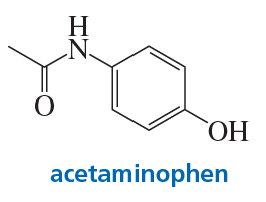
Acetaminophen is the active ingredient in Tylenol. How can acetominophen be synthesized from benzene?
Chemical structure of acetaminophen, featuring a benzene ring with an amine and hydroxyl group.

Verified step by step guidance
1
Step 1: Begin with benzene as the starting material. Benzene is an aromatic compound with a six-membered ring and alternating double bonds.
Step 2: Perform nitration of benzene using a mixture of concentrated nitric acid (HNO₃) and sulfuric acid (H₂SO₄). This introduces a nitro group (-NO₂) onto the benzene ring, forming nitrobenzene.
Step 3: Reduce the nitro group (-NO₂) in nitrobenzene to an amino group (-NH₂) using a reducing agent such as tin (Sn) and hydrochloric acid (HCl) or catalytic hydrogenation. This forms aniline.
Step 4: Acetylate the amino group (-NH₂) in aniline by reacting it with acetic anhydride (CH₃CO)₂O. This introduces an acetyl group (-COCH₃), forming acetanilide.
Step 5: Hydrolyze acetanilide under acidic or basic conditions to convert the acetyl group (-COCH₃) into a hydroxyl group (-OH), forming acetaminophen (paracetamol).

Verified video answer for a similar problem:

This video solution was recommended by our tutors as helpful for the problem above.
Video duration:
8m
Was this helpful?

Key Concepts

Here are the essential concepts you must grasp in order to answer the question correctly.

Electrophilic Aromatic Substitution

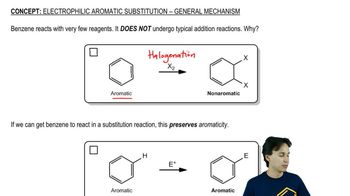
Electrophilic aromatic substitution (EAS) is a fundamental reaction in organic chemistry where an electrophile replaces a hydrogen atom on an aromatic ring. In the synthesis of acetaminophen from benzene, EAS is crucial as it allows for the introduction of functional groups, such as hydroxyl (-OH) and nitro (-NO2) groups, onto the benzene ring, setting the stage for further transformations.
Recommended video:

Nitration and Reduction

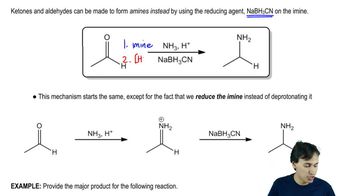
Nitration is a specific type of electrophilic aromatic substitution where a nitro group is introduced to an aromatic compound, typically using a mixture of concentrated nitric and sulfuric acids. Following nitration, the nitro group can be reduced to an amine group (-NH2) through catalytic hydrogenation or other reduction methods, which is a key step in synthesizing acetaminophen from the nitro-substituted benzene derivative.
Recommended video:
Guided course
07:12
Reductive Amination

Acetylation

Acetylation is the process of introducing an acetyl group (-COCH3) into a molecule, often using acetic anhydride or acetyl chloride. In the final steps of synthesizing acetaminophen, the hydroxyl group on the benzene derivative is acetylated to form the acetaminophen structure, which is essential for its analgesic properties. This step highlights the importance of functional group transformations in organic synthesis.
Recommended video:
0:37
The Citric Acid Cycle Example 1