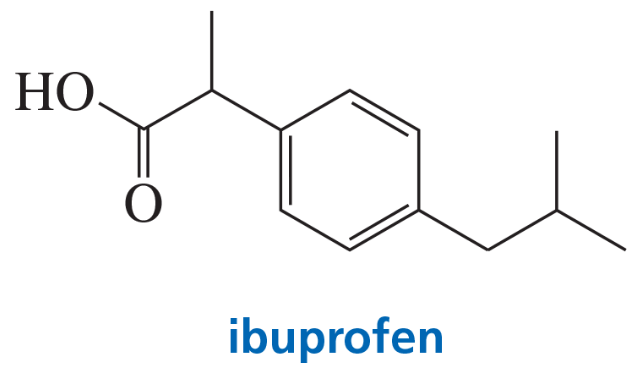
Ibuprofen is the active ingredient in pain relievers such as Advil, Motrin, and Nuprin. How can ibuprofen be synthesized from benzene?
Verified step by step guidance
1
Step 1: Begin with benzene as the starting material. Benzene is an aromatic compound with a six-membered ring and alternating double bonds. The first step is to introduce an alkyl group onto the benzene ring through Friedel-Crafts alkylation. Use isobutyl chloride (CH3CH(CH3)CH2Cl) and a Lewis acid catalyst such as AlCl3 to attach the isobutyl group to the benzene ring.
Step 2: Oxidize the alkyl group on the benzene ring to form a carboxylic acid. This can be achieved using an oxidizing agent such as potassium permanganate (KMnO4) or chromic acid (H2CrO4). The isobutyl group will be converted into a carboxylic acid (-COOH) group.
Step 3: Introduce the second alkyl group (propyl group) onto the benzene ring. This can be done through another Friedel-Crafts alkylation reaction using propyl chloride (CH3CH2CH2Cl) and AlCl3 as the catalyst. Ensure that the substitution occurs at the correct position relative to the carboxylic acid group to match the structure of ibuprofen.
Step 4: Perform a stereoselective reaction to introduce the hydroxyl group (-OH) at the alpha position of the carboxylic acid group. This step may involve enantioselective synthesis using chiral catalysts or reagents to ensure the correct stereochemistry of ibuprofen.
Step 5: Purify the final product to obtain ibuprofen. This may involve recrystallization or chromatography to isolate ibuprofen from any side products or impurities formed during the synthesis process.
Verified video answer for a similar problem:
This video solution was recommended by our tutors as helpful for the problem above.
Video duration:
8m
Play a video:
0 Comments
Was this helpful?
Key Concepts
Here are the essential concepts you must grasp in order to answer the question correctly.
Aromatic Compounds
Aromatic compounds, like benzene, are characterized by their stable ring structure and delocalized π-electrons. This stability allows for specific reactions, such as electrophilic substitution, which are crucial for synthesizing more complex molecules like ibuprofen from benzene.
Electrophilic substitution reactions are a key mechanism in organic chemistry where an electrophile replaces a hydrogen atom in an aromatic compound. This process is essential for modifying benzene to introduce functional groups that will ultimately lead to the synthesis of ibuprofen.
Nucleophiles and Electrophiles can react in Substitution Reactions.
Functional Group Transformations
Functional group transformations involve changing one functional group into another, which is vital in organic synthesis. In the case of ibuprofen, converting the introduced groups from the benzene derivative into the carboxylic acid and isobutyl groups is necessary to achieve the final structure of the drug.


 Verified step by step guidance

 01:40
01:40