Ch. 18 - Reactions of Benzene and Substituted Benzenes
Bruice - Organic Chemistry 8th Edition
Bruice8th EditionOrganic ChemistryISBN: 9780135213711Not the one you use?Change textbook
Chapter 19, Problem 101c

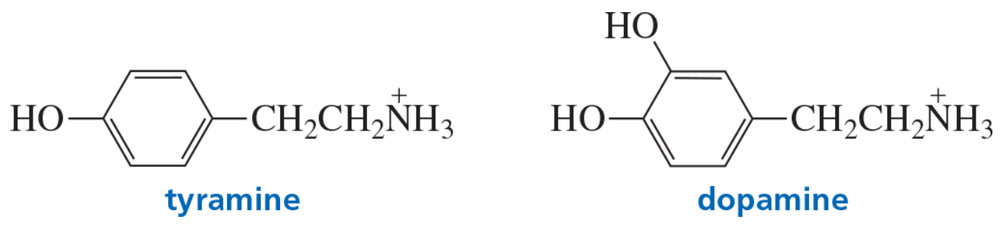
Tyramine is an alkaloid found in mistletoe and ripe cheese. Dopamine is a neurotransmitter involved in the regulation of the central nervous system.

c. Give two ways to prepare b-phenylethylamine from b-phenylethyl chloride.

Verified step by step guidance
1
Step 1: Understand the structure of β-phenylethylamine and β-phenylethyl chloride. β-phenylethylamine has the structure C6H5-CH2-CH2-NH2, while β-phenylethyl chloride has the structure C6H5-CH2-CH2-Cl. The goal is to replace the chlorine atom in β-phenylethyl chloride with an amine group (-NH2).
Step 2: Method 1 - Use nucleophilic substitution (SN2 reaction). Treat β-phenylethyl chloride with an excess of ammonia (NH3) in a polar aprotic solvent like ethanol. The chlorine atom acts as a leaving group, and ammonia acts as a nucleophile, replacing the chlorine with an amine group. The reaction proceeds as: C6H5-CH2-CH2-Cl + NH3 → C6H5-CH2-CH2-NH2 + HCl.
Step 3: Method 2 - Use Gabriel synthesis. React β-phenylethyl chloride with potassium phthalimide to form a phthalimide derivative. Then, hydrolyze the phthalimide derivative using hydrazine (NH2-NH2) to release the primary amine group. This method avoids over-alkylation and provides a clean conversion to β-phenylethylamine.
Step 4: Ensure reaction conditions are optimized. For SN2 reactions, use a polar aprotic solvent and maintain a low temperature to favor substitution over elimination. For Gabriel synthesis, ensure complete hydrolysis of the phthalimide derivative to release the amine group.
Step 5: Verify the product. Use spectroscopic techniques like NMR or IR to confirm the presence of the amine group (-NH2) and the absence of the chlorine atom in the final product. This ensures the successful conversion of β-phenylethyl chloride to β-phenylethylamine.

Key Concepts

Here are the essential concepts you must grasp in order to answer the question correctly.

Alkaloids

Alkaloids are a class of naturally occurring organic compounds that mostly contain basic nitrogen atoms. They are often derived from plant sources and have significant pharmacological effects on humans and animals. Tyramine, mentioned in the question, is an alkaloid that can influence neurotransmitter release and is found in various foods, particularly aged cheeses.

Nucleophilic Substitution Reactions

Nucleophilic substitution reactions are fundamental organic reactions where a nucleophile attacks an electrophilic carbon atom, replacing a leaving group. In the context of preparing β-phenylethylamine from β-phenylethyl chloride, understanding this mechanism is crucial, as it involves the substitution of the chloride ion with an amine group, typically using a nucleophile like ammonia or an amine.
Recommended video:
Guided course
01:47
Nucleophiles and Electrophiles can react in Substitution Reactions.

Amines and Their Reactivity

Amines are organic compounds derived from ammonia by replacing one or more hydrogen atoms with alkyl or aryl groups. They are characterized by their basicity and nucleophilicity, making them reactive towards electrophiles. In the synthesis of β-phenylethylamine, the reactivity of amines plays a key role, as they can act as nucleophiles in substitution reactions, facilitating the conversion from halides to amines.
Recommended video:
Guided course
07:12
Reductive Amination