Ch. 18 - Reactions of Benzene and Substituted Benzenes
Bruice - Organic Chemistry 8th Edition
Bruice8th EditionOrganic ChemistryISBN: 9780135213711Not the one you use?Change textbook
Chapter 19, Problem 44

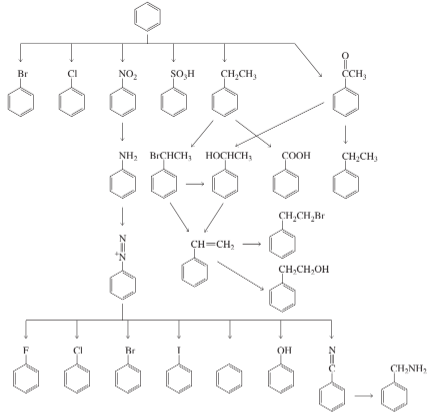
Provide the necessary reagents next to the arrows.
Diagram illustrating aromatic compound transformations with reagents indicated next to reaction arrows.

Verified step by step guidance
1
Analyze the reaction scheme provided. Identify the starting material, the intermediate(s), and the final product. This will help you determine the type of reaction(s) involved (e.g., substitution, elimination, addition, oxidation, reduction, etc.).
Determine the functional group transformations occurring in each step. For example, if an alcohol is converted to a ketone, this suggests an oxidation reaction.
Based on the functional group transformation, select the appropriate reagent(s). For example, if an alkene is being converted to an alcohol, reagents like BH₃/THF followed by H₂O₂/NaOH (hydroboration-oxidation) or Hg(OAc)₂/H₂O followed by NaBH₄ (oxymercuration-demercuration) might be used.
Consider the reaction conditions (e.g., temperature, solvent, and stereochemistry). For example, if stereospecificity is required, choose reagents that provide the desired stereochemical outcome.
Write the reagents next to the arrows in the reaction scheme, ensuring they correspond to the transformations occurring in each step. Double-check that the reagents are appropriate for the specific reaction type and conditions.

Verified video answer for a similar problem:

This video solution was recommended by our tutors as helpful for the problem above.
Video duration:
4m
Was this helpful?

Key Concepts

Here are the essential concepts you must grasp in order to answer the question correctly.

Reagents in Organic Reactions

Reagents are substances that are added to a chemical reaction to cause a transformation. In organic chemistry, they can include acids, bases, oxidizing agents, reducing agents, and catalysts. Understanding the role of each reagent is crucial for predicting the outcome of a reaction and determining the necessary conditions for the reaction to proceed.
Recommended video:
Guided course
02:17
Identifying organic molecules

Reaction Mechanisms

A reaction mechanism describes the step-by-step process by which reactants are converted into products. It includes the breaking and forming of bonds, the movement of electrons, and the intermediates formed during the reaction. Familiarity with mechanisms helps in understanding how reagents interact and the specific conditions required for a reaction to occur.
Recommended video:
Guided course
02:16
Heck Reaction Mechanism

Functional Groups

Functional groups are specific groups of atoms within molecules that are responsible for the characteristic chemical reactions of those molecules. They determine the reactivity and properties of organic compounds. Recognizing functional groups is essential for predicting how different reagents will interact with a substrate in a reaction.
Recommended video:
Guided course
02:36
Identifying Functional Groups