Ch. 18 - Reactions of Benzene and Substituted Benzenes
Bruice - Organic Chemistry 8th Edition
Bruice8th EditionOrganic ChemistryISBN: 9780135213711Not the one you use?Change textbook
Chapter 19, Problem 45b

Draw the structure for each of the following:
b. p-nitrobenzenesulfonic acid

Verified step by step guidance
1
Step 1: Start with the benzene ring as the base structure. Benzene is a six-membered aromatic ring with alternating double bonds.
Step 2: Identify the substituents. The problem specifies 'p-nitrobenzenesulfonic acid,' which means there are two substituents: a nitro group (-NO₂) and a sulfonic acid group (-SO₃H).
Step 3: Place the substituents in the para (p-) position. In the para configuration, the substituents are located opposite each other on the benzene ring (i.e., at positions 1 and 4).
Step 4: Attach the nitro group (-NO₂) to one carbon of the benzene ring. This group consists of a nitrogen atom double-bonded to one oxygen atom and single-bonded to another oxygen atom (which carries a negative charge, balanced by a positive charge on the nitrogen).
Step 5: Attach the sulfonic acid group (-SO₃H) to the carbon directly opposite the nitro group. This group consists of a sulfur atom double-bonded to two oxygen atoms and single-bonded to a hydroxyl group (-OH). Ensure the structure reflects the para arrangement of the substituents.

Verified video answer for a similar problem:

This video solution was recommended by our tutors as helpful for the problem above.
Video duration:
2m
Was this helpful?

Key Concepts

Here are the essential concepts you must grasp in order to answer the question correctly.

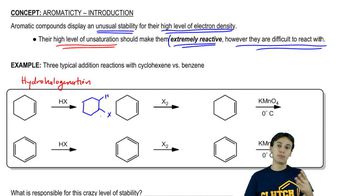
Aromatic Compounds

Aromatic compounds are a class of cyclic compounds that follow Huckel's rule, possessing a planar structure and delocalized pi electrons. They exhibit unique stability due to resonance, which is crucial for understanding the reactivity and properties of compounds like p-nitrobenzenesulfonic acid. Recognizing the aromatic nature of the benzene ring is essential for drawing its structure accurately.
Recommended video:
Guided course
08:19
Intro to Aromaticity

Functional Groups

Functional groups are specific groups of atoms within molecules that are responsible for the characteristic chemical reactions of those molecules. In p-nitrobenzenesulfonic acid, the sulfonic acid (-SO3H) and nitro (-NO2) groups are key functional groups that influence the compound's acidity and reactivity. Understanding these groups is vital for constructing the correct molecular structure.
Recommended video:
Guided course
02:36
Identifying Functional Groups

Nomenclature of Organic Compounds

Nomenclature refers to the systematic naming of organic compounds based on their structure and functional groups. The name p-nitrobenzenesulfonic acid indicates the presence of a nitro group at the para position relative to the sulfonic acid group on a benzene ring. Familiarity with IUPAC naming conventions helps in accurately interpreting and drawing the structures of organic molecules.
Recommended video:
Guided course
01:40
Defining meso compounds.