Ch. 18 - Reactions of Benzene and Substituted Benzenes
Bruice - Organic Chemistry 8th Edition
Bruice8th EditionOrganic ChemistryISBN: 9780135213711Not the one you use?Change textbook
Chapter 19, Problem 45e

Draw the structure for each of the following:
e. 4-bromo-1-chloro-2-methylbenzene

Verified step by step guidance
1
Step 1: Begin by identifying the parent structure. The parent structure is benzene, which is a six-membered aromatic ring with alternating double bonds.
Step 2: Number the positions on the benzene ring. Start numbering from the position where the substituent with the highest priority is attached. In this case, bromine (Br) has higher priority than chlorine (Cl) and methyl (CH₃), so bromine is at position 4.
Step 3: Place the chlorine substituent at position 1. This is specified in the name '1-chloro'.
Step 4: Place the methyl group (CH₃) at position 2. This is specified in the name '2-methyl'.
Step 5: Draw the benzene ring and add the substituents at their respective positions: bromine at position 4, chlorine at position 1, and methyl at position 2. Ensure the structure maintains the aromaticity of the benzene ring.

Verified video answer for a similar problem:

This video solution was recommended by our tutors as helpful for the problem above.
Video duration:
2m
Was this helpful?

Key Concepts

Here are the essential concepts you must grasp in order to answer the question correctly.

Benzene Structure

Benzene is a cyclic hydrocarbon with a formula of C6H6, characterized by its planar structure and resonance stability. It consists of six carbon atoms arranged in a hexagonal ring, with alternating double bonds. Understanding the basic structure of benzene is crucial for drawing substituted derivatives, as it serves as the foundation for further modifications.
Recommended video:
Guided course
09:04
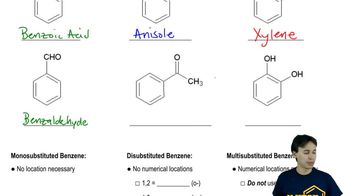
Benzene Nomenclature

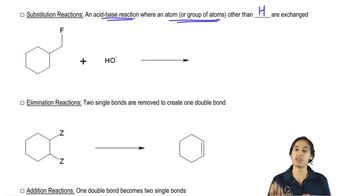
Substitution Reactions

In organic chemistry, substitution reactions involve replacing one atom or group in a molecule with another. For benzene derivatives, electrophilic aromatic substitution is common, where substituents like bromine and chlorine can replace hydrogen atoms. Recognizing how these reactions occur helps in accurately depicting the final structure of substituted benzene compounds.
Recommended video:
Guided course
01:34
Recognizing Substitution Reactions.

Nomenclature of Organic Compounds

The IUPAC nomenclature system provides a standardized method for naming organic compounds based on their structure. In the case of 4-bromo-1-chloro-2-methylbenzene, the name indicates the positions of the substituents on the benzene ring. Understanding how to interpret and apply these naming conventions is essential for correctly drawing and identifying organic structures.
Recommended video:
Guided course
01:40
Defining meso compounds.