Ch. 16 - Reactions of Aldehydes and Ketones • More Reactions of Carboxylic Acid Derivatives
Bruice - Organic Chemistry 8th Edition
Bruice8th EditionOrganic ChemistryISBN: 9780135213711Not the one you use?Change textbook
Chapter 17, Problem 58f

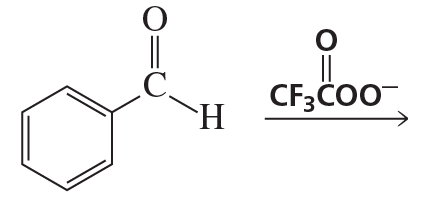
Draw the products of the following reactions. Indicate whether each reaction is an oxidation or a reduction.
f. Chemical reaction diagram showing a benzaldehyde structure and its conversion to a carboxylate ion, indicating oxidation.

Verified step by step guidance
1
Analyze the reactant: The given compound is cyclohexanecarbaldehyde, which contains an aldehyde functional group (-CHO). Aldehydes are susceptible to oxidation reactions.
Identify the reagent: The reagent provided is trifluoroacetate (CF₃COO⁻), which is commonly used in oxidation reactions. This suggests that the aldehyde group will likely be oxidized.
Predict the product: In an oxidation reaction, the aldehyde group (-CHO) is typically converted into a carboxylic acid group (-COOH). Therefore, the product will likely be cyclohexanecarboxylic acid.
Classify the reaction: Since the aldehyde is losing electrons (oxidation involves the loss of electrons), this reaction is classified as an oxidation reaction.
Draw the product: The structure of the product will be cyclohexane with a carboxylic acid group (-COOH) attached to the carbon that originally had the aldehyde group.

Verified video answer for a similar problem:

This video solution was recommended by our tutors as helpful for the problem above.
Video duration:
3m
Was this helpful?

Key Concepts

Here are the essential concepts you must grasp in order to answer the question correctly.

Oxidation and Reduction

Oxidation and reduction are fundamental concepts in organic chemistry that describe the transfer of electrons between species. Oxidation involves the loss of electrons or an increase in oxidation state, while reduction involves the gain of electrons or a decrease in oxidation state. Understanding these processes is crucial for predicting the products of chemical reactions, especially in organic transformations.
Recommended video:
Guided course
00:54
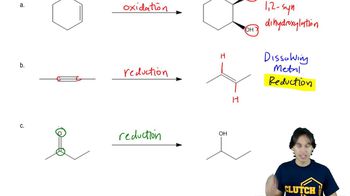
Distinguishing between Oxidation and Reduction

Functional Groups

Functional groups are specific groups of atoms within molecules that are responsible for the characteristic chemical reactions of those molecules. In the context of the provided reaction, recognizing the functional groups, such as alcohols, ketones, or carboxylic acids, is essential for determining how the molecule will react and what products will form during oxidation or reduction.
Recommended video:
Guided course
02:36
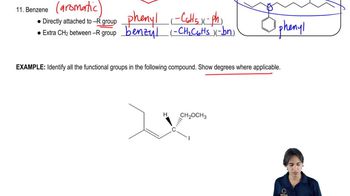
Identifying Functional Groups

Reaction Mechanisms

Reaction mechanisms describe the step-by-step sequence of elementary reactions by which overall chemical change occurs. Understanding the mechanism of a reaction helps in predicting the products and understanding the role of catalysts or reagents. In the case of the reaction shown, knowing the mechanism can clarify how the cyclohexanol derivative is oxidized and what intermediates may be involved.
Recommended video:
Guided course
02:16
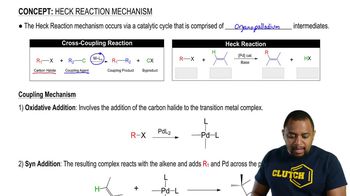
Heck Reaction Mechanism