Ch. 16 - Reactions of Aldehydes and Ketones • More Reactions of Carboxylic Acid Derivatives
Bruice - Organic Chemistry 8th Edition
Bruice8th EditionOrganic ChemistryISBN: 9780135213711Not the one you use?Change textbook
Chapter 17, Problem 58a,b,c

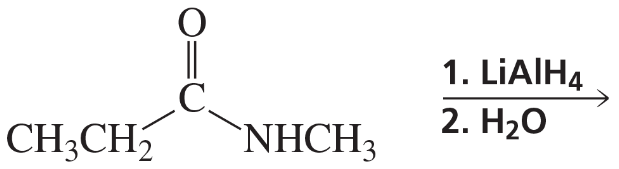
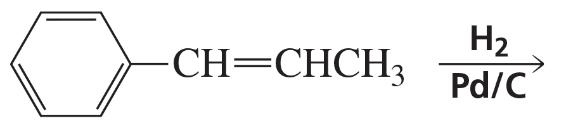
Draw the products of the following reactions. Indicate whether each reaction is an oxidation or a reduction.
a.
b.
c.

Verified step by step guidance
1
Step 1: Analyze the first reaction. The reagent Na in liquid NH₃ is used for the partial reduction of alkynes to trans-alkenes. This reaction is stereospecific and results in the formation of a trans-alkene. Identify the alkyne in the starting material and predict the trans-alkene product.
Step 2: For the second reaction, LiAlH₄ is a strong reducing agent that reduces amides to amines. The carbonyl group (C=O) in the amide will be reduced, and the resulting product will be an amine. Write the structure of the amine product by replacing the carbonyl group with a CH₂ group.
Step 3: Examine the third reaction. The reagent H₂ with Pd/C is used for catalytic hydrogenation. This reaction reduces alkenes to alkanes by adding hydrogen across the double bond. Identify the alkene in the starting material and predict the alkane product.
Step 4: Determine whether each reaction is an oxidation or a reduction. Reduction involves the gain of hydrogen or loss of oxygen, while oxidation involves the loss of hydrogen or gain of oxygen. Based on the reagents and products, classify each reaction accordingly.
Step 5: Draw the products for each reaction, ensuring the stereochemistry and functional group changes are accurately represented. Label each product with its corresponding reaction type (oxidation or reduction).

Verified video answer for a similar problem:

This video solution was recommended by our tutors as helpful for the problem above.
Video duration:
7m
Was this helpful?

Key Concepts

Here are the essential concepts you must grasp in order to answer the question correctly.

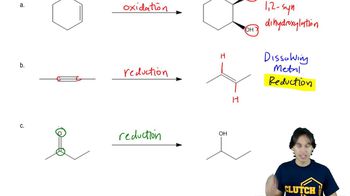
Oxidation and Reduction

Oxidation and reduction are fundamental concepts in organic chemistry that describe the transfer of electrons between species. Oxidation involves the loss of electrons or an increase in oxidation state, while reduction involves the gain of electrons or a decrease in oxidation state. Understanding these processes is crucial for predicting the products of chemical reactions.
Recommended video:
Guided course
00:54
Distinguishing between Oxidation and Reduction

Reaction Mechanisms

Reaction mechanisms detail the step-by-step sequence of events that occur during a chemical reaction. They provide insight into how reactants transform into products, including the breaking and forming of bonds. Familiarity with common mechanisms, such as nucleophilic substitution or elimination, is essential for accurately drawing reaction products.
Recommended video:
Guided course
02:16
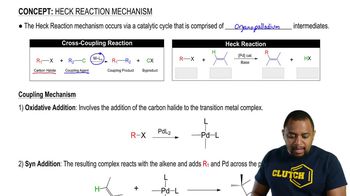
Heck Reaction Mechanism

Functional Groups

Functional groups are specific groups of atoms within molecules that are responsible for the characteristic chemical reactions of those molecules. Recognizing functional groups is vital for predicting how different compounds will react in oxidation or reduction processes. Examples include alcohols, aldehydes, and ketones, each exhibiting unique reactivity patterns.
Recommended video:
Guided course
02:36
Identifying Functional Groups