Ch. 13 - Mass Spectrometry; Infrared Spectroscopy; UV/Vis Spectroscopy
Bruice - Organic Chemistry 8th Edition
Bruice8th EditionOrganic ChemistryISBN: 9780135213711Not the one you use?Change textbook
Chapter 14, Problem 44

Rank the following compounds in order of increasing lmax:
Four chemical structures labeled A, B, C, and D, illustrating compounds for ranking by increasing lmax.

Verified step by step guidance
1
Step 1: Understand the concept of λmax (maximum wavelength of absorption). λmax is influenced by the extent of conjugation in a molecule. Greater conjugation leads to a higher λmax because the energy gap between the HOMO and LUMO decreases.
Step 2: Analyze the structures provided. Compound A has one double bond, Compound B has two conjugated double bonds, Compound C has three conjugated double bonds, and Compound D has two conjugated double bonds but lacks aromaticity.
Step 3: Rank the compounds based on the extent of conjugation. Compound C has the most conjugation (three double bonds), followed by Compounds B and D (two conjugated double bonds), and finally Compound A (one double bond).
Step 4: Consider additional factors such as aromaticity. Compound B has aromaticity due to the benzene ring, which stabilizes the conjugated system and increases λmax compared to Compound D.
Step 5: Final ranking in order of increasing λmax: Compound A < Compound D < Compound B < Compound C.

Verified video answer for a similar problem:

This video solution was recommended by our tutors as helpful for the problem above.
Video duration:
2m
Was this helpful?

Key Concepts

Here are the essential concepts you must grasp in order to answer the question correctly.

Conjugation

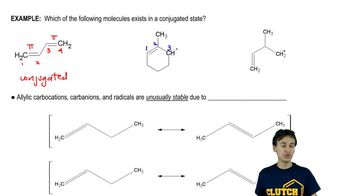
Conjugation refers to the overlap of p-orbitals across adjacent double bonds or lone pairs, allowing for delocalization of electrons. This delocalization lowers the energy of the molecule and increases the wavelength of light absorbed, leading to higher λmax values. The extent of conjugation directly influences the color and reactivity of organic compounds.
Recommended video:
Guided course
03:27
Conjugated states

λmax (Lambda Max)

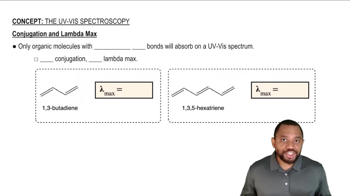
λmax is the wavelength at which a compound exhibits maximum absorbance in UV-Vis spectroscopy. It is influenced by the electronic structure of the molecule, particularly the presence of conjugated systems. Compounds with more extensive conjugation typically have higher λmax values due to lower energy gaps between their ground and excited states.
Recommended video:
1:44
The UV-Vis Spectroscopy Concept 3

Electron-Withdrawing and Electron-Donating Groups

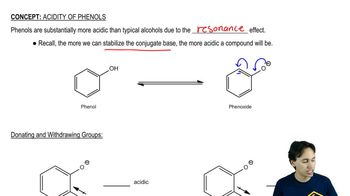
Electron-withdrawing groups (EWGs) decrease electron density in a molecule, often lowering λmax, while electron-donating groups (EDGs) increase electron density, typically raising λmax. The presence and position of these groups in relation to the conjugated system can significantly affect the electronic transitions and, consequently, the absorption properties of the compounds.
Recommended video:
Guided course
02:37
Donating vs Withdrawing Groups