Ch. 13 - Mass Spectrometry; Infrared Spectroscopy; UV/Vis Spectroscopy
Bruice - Organic Chemistry 8th Edition
Bruice8th EditionOrganic ChemistryISBN: 9780135213711Not the one you use?Change textbook
Chapter 14, Problem 38a

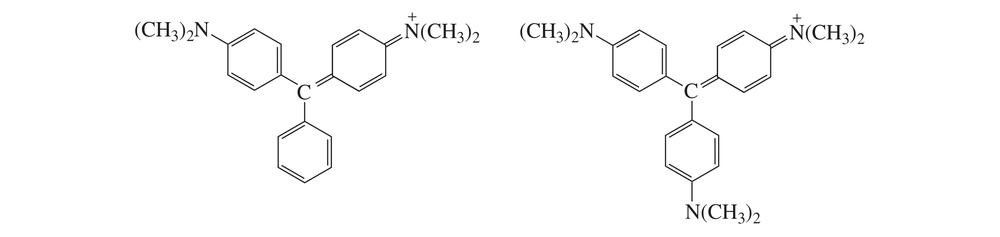
At pH = 7, one of the ions shown here is purple and the other is blue. Which is which?
Chemical structures of two conjugated ions, one depicted in purple and the other in blue, at pH 7.

Verified step by step guidance
1
Examine the chemical structures of Compound A and Compound B. Both compounds contain aromatic rings and amine groups, but their arrangement differs slightly.
At pH = 7, the protonation state of the amine groups is critical. The positively charged amine group (NH3+) indicates that the compound is in its protonated form, which can influence its color due to electronic transitions in the molecule.
Consider the conjugation and resonance effects in each compound. The arrangement of the aromatic rings and the amine groups affects the delocalization of electrons, which in turn impacts the absorption of light and the observed color.
Compound A has a more linear arrangement of aromatic rings, while Compound B has a slightly more branched structure. This difference in structure can lead to variations in electronic transitions and thus different colors.
Based on the structural differences and the protonation state at pH = 7, the observed colors (purple and blue) are likely due to the specific electronic transitions in each compound. To determine which compound corresponds to each color, further experimental data or reference to known absorption spectra would be required.

Verified video answer for a similar problem:

This video solution was recommended by our tutors as helpful for the problem above.
Video duration:
3m
Was this helpful?

Key Concepts

Here are the essential concepts you must grasp in order to answer the question correctly.

Ionization and pH

Ionization refers to the process by which a molecule gains or loses protons (H+ ions), affecting its charge. At a specific pH, certain functional groups in compounds can become protonated or deprotonated. For example, at pH 7, amino groups (-NH2) can exist in a protonated form (-NH3+) or remain neutral, influencing the overall charge and color of the compound.
Recommended video:
Guided course
04:28
Ionization Potentials

Color Indicators in Chemistry

In organic chemistry, certain compounds exhibit different colors based on their ionic state, which can be influenced by pH. The color change is often due to the presence of conjugated systems or specific functional groups that absorb light at different wavelengths. Understanding which ion corresponds to which color can help identify the protonation state of the compounds.
Recommended video:
Guided course
00:28
Introduction to General Chemistry Review

Structural Differences in Compounds

The structural differences between compounds can significantly affect their chemical properties, including their ionization behavior. In the provided compounds, the arrangement of amino groups and phenyl rings can lead to different stabilization of the charged forms, resulting in distinct colors at a given pH. Analyzing these structures helps predict their behavior in solution.
Recommended video:
Guided course
04:10
The 3 rules of meso compounds.