Ch. 13 - Mass Spectrometry; Infrared Spectroscopy; UV/Vis Spectroscopy
Bruice - Organic Chemistry 8th Edition
Bruice8th EditionOrganic ChemistryISBN: 9780135213711Not the one you use?Change textbook
Chapter 14, Problem 38b

What would be the difference in the colors of the compounds at pH = 3?

Verified step by step guidance
1
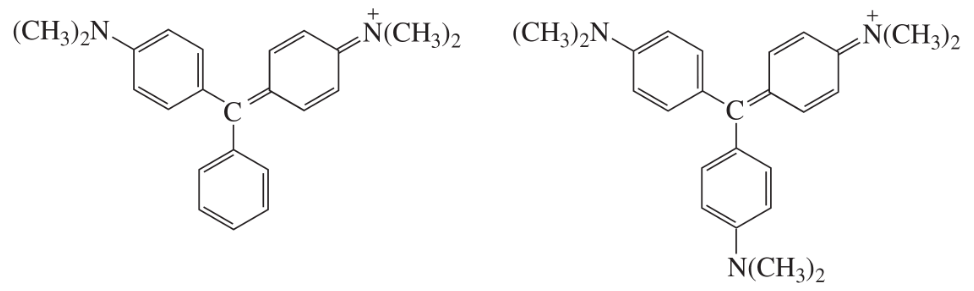
Analyze the chemical structures provided in the image. Both compounds are triarylmethane derivatives with substituents that include dimethylamino groups ((CH3)2N) and a positively charged dimethylamino group (N+(CH3)2). The second compound has an additional dimethylamino group attached to the third aromatic ring.
Understand the role of pH = 3. At this acidic pH, protonation of basic groups (such as the dimethylamino groups) is likely to occur. Protonation can affect the electronic structure and conjugation of the molecule, which in turn influences the color of the compound.
Consider the electronic effects of protonation. Protonation of the dimethylamino groups reduces their electron-donating ability, disrupting conjugation with the aromatic rings. This change in conjugation alters the absorption of light and thus the color of the compound.
Compare the two compounds. The first compound has one positively charged dimethylamino group, while the second compound has two dimethylamino groups and one positively charged dimethylamino group. The second compound has more electron-donating groups, which may result in a different conjugation pattern and color response at pH = 3.
Predict the difference in colors. The first compound, with fewer electron-donating groups, may exhibit a color shift toward shorter wavelengths (blue or violet), while the second compound, with more electron-donating groups, may retain absorption at longer wavelengths (red or orange). The exact colors depend on the extent of conjugation and protonation effects.

Verified video answer for a similar problem:

This video solution was recommended by our tutors as helpful for the problem above.
Video duration:
5m
Was this helpful?

Key Concepts

Here are the essential concepts you must grasp in order to answer the question correctly.

pH and Color Change in Organic Compounds

The pH of a solution can significantly affect the ionization state of organic compounds, particularly those that are weak acids or bases. At different pH levels, these compounds may exist in protonated or deprotonated forms, which can lead to changes in their electronic structure and, consequently, their color. Understanding how pH influences these states is crucial for predicting color differences.
Recommended video:
Guided course
04:39
How to name a bridged bicyclic

Acid-Base Chemistry

Acid-base chemistry involves the transfer of protons (H+) between species, which can alter the properties of compounds. In the context of organic compounds, the presence of functional groups such as carboxylic acids or amines can lead to different colors at varying pH levels due to their ability to gain or lose protons. This concept is essential for analyzing how compounds behave in acidic or basic environments.
Recommended video:
Guided course
02:49
The Lewis definition of acids and bases.

Chromophores and Color Perception

Chromophores are parts of molecules responsible for their color, typically due to the presence of conjugated double bonds or specific functional groups. The interaction of light with these chromophores can change based on their electronic state, which is influenced by pH. Understanding how chromophores work helps explain why compounds may appear differently colored at different pH levels.
Recommended video:
3:11
Chemical Reactions of Phosphate Anhydrides Concept 1