Ch. 10 - Reactions of Alcohols, Ethers, Epoxides, Amines, and Sulfur-Containing Compounds
Bruice - Organic Chemistry 8th Edition
Bruice8th EditionOrganic ChemistryISBN: 9780135213711Not the one you use?Change textbook
Chapter 11, Problem 33c,d

What stereoisomers are obtained from the reaction of the alkenes in [PROBLEM 10-32] with a peroxyacid ­followed by reaction with hydroxide ion?
c. cis-2-pentene
d. trans-2-pentene

Verified step by step guidance
1
Identify the reaction type: The reaction involves the conversion of an alkene into an epoxide using a peroxyacid (e.g., mCPBA) followed by a ring-opening reaction with hydroxide ion. This is a two-step reaction mechanism.
Step 1: Epoxidation of the alkene. The alkene reacts with the peroxyacid to form an epoxide. The stereochemistry of the alkene determines the stereochemistry of the epoxide. If the alkene is cis, the epoxide will be cis; if the alkene is trans, the epoxide will be trans. Represent the epoxide structure using MathML if needed.
Step 2: Ring-opening of the epoxide. The hydroxide ion attacks the less sterically hindered carbon of the epoxide in an SN2 mechanism. This results in the formation of a diol. The attack inverts the stereochemistry at the carbon being attacked, leading to anti stereochemistry in the product.
Analyze the stereoisomers: Depending on the stereochemistry of the starting alkene (cis or trans), the reaction will yield different stereoisomers of the diol. For example, a cis-alkene will produce enantiomers of the anti diol, while a trans-alkene will also produce enantiomers of the anti diol but with different stereochemical configurations.
Summarize the stereoisomers: List the possible stereoisomers (e.g., R,R and S,S or R,S and S,R) based on the starting alkene's configuration. Ensure to clearly represent the stereochemistry using wedge-dash notation or MathML for clarity.

Verified video answer for a similar problem:

This video solution was recommended by our tutors as helpful for the problem above.
Video duration:
5m
Was this helpful?

Key Concepts

Here are the essential concepts you must grasp in order to answer the question correctly.

Stereoisomerism

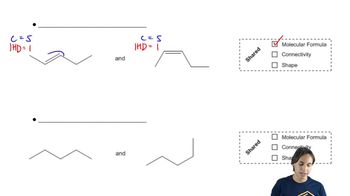
Stereoisomerism refers to the phenomenon where compounds have the same molecular formula and connectivity of atoms but differ in the spatial arrangement of those atoms. This can lead to different physical and chemical properties. In organic chemistry, stereoisomers include enantiomers and diastereomers, which are crucial for understanding the outcomes of reactions involving chiral centers.
Recommended video:
Guided course
01:58
Determining when molecules are stereoisomers.

Epoxidation

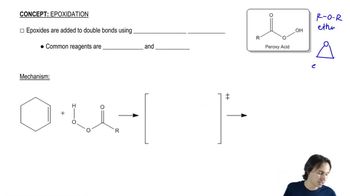
Epoxidation is a chemical reaction that converts alkenes into epoxides, which are three-membered cyclic ethers. This reaction is typically facilitated by peroxyacids, such as m-chloroperbenzoic acid (MCPBA). The formation of epoxides introduces a reactive functional group that can undergo further reactions, influencing the stereochemistry of the resulting products.
Recommended video:
Guided course
02:19
General properties of epoxidation.

Nucleophilic Ring Opening

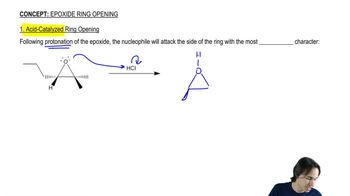
Nucleophilic ring opening is a reaction where a nucleophile attacks an electrophilic carbon in a strained ring structure, such as an epoxide. This process often leads to the formation of diols and can result in the generation of stereoisomers depending on the stereochemistry of the starting material and the nucleophile's approach. The reaction with hydroxide ion after epoxidation is a common example of this mechanism.
Recommended video:
Guided course
04:34
Acid-Catalyzed Epoxide Ring-Opening