Textbook Question
Draw the mechanism for formation of the two addition products.
2
views

 Bruice 8th EditionCh. 10 - Reactions of Alcohols, Ethers, Epoxides, Amines, and Sulfur-Containing CompoundsProblem 36a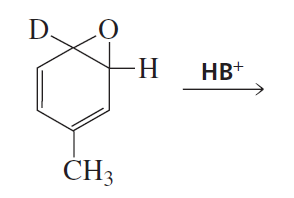
 Verified step by step guidance
 03:43
03:43
 03:20
03:20 03:06
03:06Draw the mechanism for formation of the two addition products.
Draw all possible resonance contributors for the two carbocations in the preceding reaction. Use the resonance contributors to explain why 1-naphthol is the major product of the reaction.
Explain why the two arene oxides in [PROBLEM 10-38] open in opposite directions.
How do the major products obtained from rearrangement of the following arene oxides differ?
What stereoisomers are obtained from the reaction of the alkenes in [PROBLEM 10-32] with a peroxyacid followed by reaction with hydroxide ion?
c. cis-2-pentene
d. trans-2-pentene
The existence of the NIH shift was established by determining the major product obtained from rearrangement of the following arene oxide, in which a hydrogen has been replaced by a deuterium.
b. What would be the major product if the carbocation forms phenol by losing H+ or D+, rather than by going through the NIH shift?