Textbook Question
Draw all possible resonance contributors for the two carbocations in the preceding reaction. Use the resonance contributors to explain why 1-naphthol is the major product of the reaction.
6
views

 Bruice 8th EditionCh. 10 - Reactions of Alcohols, Ethers, Epoxides, Amines, and Sulfur-Containing CompoundsProblem 37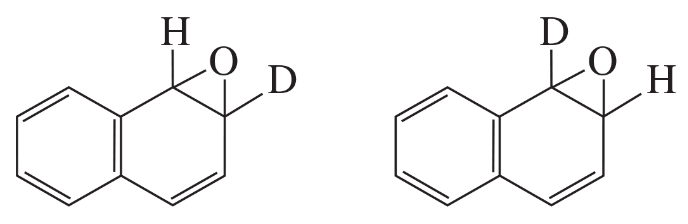
 Verified step by step guidance
 03:40
03:40
 06:28
06:28 11:07
11:07Draw all possible resonance contributors for the two carbocations in the preceding reaction. Use the resonance contributors to explain why 1-naphthol is the major product of the reaction.
Three arene oxides can be obtained from phenanthrene.
a. Draw the structures of the three phenanthrene oxides.
Explain why the two arene oxides in [PROBLEM 10-38] open in opposite directions.
The existence of the NIH shift was established by determining the major product obtained from rearrangement of the following arene oxide, in which a hydrogen has been replaced by a deuterium.
a. What would be the major product if the NIH shift occurs? (Hint: A C—H bond is easier to break than a C—D bond.)
The existence of the NIH shift was established by determining the major product obtained from rearrangement of the following arene oxide, in which a hydrogen has been replaced by a deuterium.
b. What would be the major product if the carbocation forms phenol by losing H+ or D+, rather than by going through the NIH shift?
Three arene oxides can be obtained from phenanthrene.
c. If a phenanthrene oxide can lead to the formation of more than one phenol, which phenol will be obtained in greater yield?