Ch. 10 - Reactions of Alcohols, Ethers, Epoxides, Amines, and Sulfur-Containing Compounds
Bruice - Organic Chemistry 8th Edition
Bruice8th EditionOrganic ChemistryISBN: 9780135213711Not the one you use?Change textbook
Chapter 11, Problem 32a,b

What stereoisomers are obtained from the reaction of each of the following alkenes with OsO4 followed by aqueous H2O2?
a. trans-2-butene
b. cis-2-butene

Verified step by step guidance
1
Step 1: Understand the reaction mechanism. The reaction of an alkene with OsO₄ (osmium tetroxide) followed by aqueous H₂O₂ (hydrogen peroxide) is a syn-dihydroxylation reaction. This means that two hydroxyl (-OH) groups are added to the same side (syn addition) of the double bond in the alkene.
Step 2: Analyze the structure of trans-2-butene. In trans-2-butene, the two methyl groups are on opposite sides of the double bond. When OsO₄ reacts with trans-2-butene, the syn addition of -OH groups will occur on the same face of the double bond, leading to the formation of a meso compound (a compound with an internal plane of symmetry).
Step 3: Analyze the structure of cis-2-butene. In cis-2-butene, the two methyl groups are on the same side of the double bond. When OsO₄ reacts with cis-2-butene, the syn addition of -OH groups will occur on the same face of the double bond, resulting in the formation of a pair of enantiomers (non-superimposable mirror images).
Step 4: Consider stereochemistry. For trans-2-butene, the product is a meso compound because the syn addition creates a molecule with an internal plane of symmetry. For cis-2-butene, the syn addition creates two stereocenters, leading to a racemic mixture of enantiomers.
Step 5: Summarize the stereoisomers. The reaction of trans-2-butene with OsO₄ followed by H₂O₂ produces a single meso compound. The reaction of cis-2-butene with OsO₄ followed by H₂O₂ produces a racemic mixture of two enantiomers.

Verified video answer for a similar problem:

This video solution was recommended by our tutors as helpful for the problem above.
Video duration:
3m
Was this helpful?

Key Concepts

Here are the essential concepts you must grasp in order to answer the question correctly.

Stereoisomerism

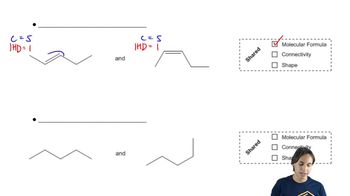
Stereoisomerism refers to the phenomenon where compounds have the same molecular formula and connectivity of atoms but differ in the spatial arrangement of those atoms. This can lead to different physical and chemical properties. In the context of alkenes, stereoisomers can be classified as cis or trans, depending on the relative positions of substituents around the double bond.
Recommended video:
Guided course
01:58
Determining when molecules are stereoisomers.

OsO4 (Osmium Tetroxide) Reaction

The reaction of alkenes with OsO4 is a syn-dihydroxylation process, where osmium tetroxide adds across the double bond of the alkene, resulting in the formation of a cyclic osmate ester. This reaction is stereospecific, meaning it produces diols with specific stereochemistry, leading to the formation of stereoisomers based on the starting alkene's configuration.
Recommended video:
Guided course
05:09
Heck Reaction

Hydrogen Peroxide (H2O2) in Organic Reactions

Hydrogen peroxide (H2O2) is often used in organic reactions as an oxidizing agent. In the context of the OsO4 reaction, H2O2 is used to hydrolyze the osmate ester formed, yielding vicinal diols. The stereochemistry of the resulting diols is influenced by the initial configuration of the alkene, which is crucial for determining the final stereoisomers produced.
Recommended video:
3:55
Triacylglycerol Reactions: Hydrogenation Concept 1