Ch. 10 - Reactions of Alcohols, Ethers, Epoxides, Amines, and Sulfur-Containing Compounds
Bruice - Organic Chemistry 8th Edition
Bruice8th EditionOrganic ChemistryISBN: 9780135213711Not the one you use?Change textbook
Chapter 11, Problem 30a

What products are obtained from the reaction of cyclohexene oxide with
a. methoxide ion?

Verified step by step guidance
1
Identify the structure of cyclohexene oxide. Cyclohexene oxide is an epoxide, which is a three-membered cyclic ether containing an oxygen atom. The strained ring makes it highly reactive towards nucleophiles.
Understand the role of the methoxide ion (CH₃O⁻). Methoxide is a strong nucleophile and a strong base. In this reaction, it will act as a nucleophile to open the epoxide ring.
Determine the regioselectivity of the reaction. In the case of an epoxide, the nucleophile attacks the less sterically hindered carbon of the epoxide ring in a basic medium. This is due to the SN2 mechanism, which favors less hindered carbons.
Write the mechanism of the reaction. The methoxide ion attacks the less substituted carbon of the epoxide ring, leading to the opening of the ring. This results in the formation of an alkoxide intermediate.
Protonate the alkoxide intermediate. The alkoxide ion formed in the previous step will be protonated by a proton source (e.g., methanol or water) to yield the final product, which is a 1-methoxy-2-cyclohexanol.

Verified video answer for a similar problem:

This video solution was recommended by our tutors as helpful for the problem above.
Video duration:
5m
Was this helpful?

Key Concepts

Here are the essential concepts you must grasp in order to answer the question correctly.

Epoxide Chemistry

Epoxides, or oxiranes, are three-membered cyclic ethers that are highly reactive due to the strain in their ring structure. They can undergo various nucleophilic ring-opening reactions, where a nucleophile attacks the less hindered carbon atom of the epoxide, leading to the formation of diols or other functional groups depending on the nucleophile used.
Recommended video:
Guided course
02:19
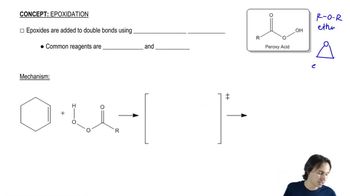
General properties of epoxidation.

Nucleophilic Substitution

Nucleophilic substitution is a fundamental reaction mechanism in organic chemistry where a nucleophile replaces a leaving group in a molecule. In the case of cyclohexene oxide reacting with methoxide ion, the methoxide acts as a nucleophile, attacking the epoxide and resulting in the opening of the ring, which leads to the formation of an alcohol.
Recommended video:
Guided course
01:47
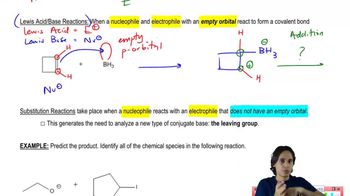
Nucleophiles and Electrophiles can react in Substitution Reactions.

Reaction Mechanism

Understanding the reaction mechanism is crucial for predicting the products of a chemical reaction. In this scenario, the mechanism involves the nucleophilic attack of the methoxide ion on the epoxide, followed by the opening of the three-membered ring, which can lead to the formation of a specific alcohol product, depending on the regioselectivity of the attack.
Recommended video:
Guided course
02:16
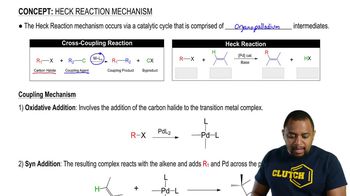
Heck Reaction Mechanism