Ch. 10 - Reactions of Alcohols, Ethers, Epoxides, Amines, and Sulfur-Containing Compounds
Bruice - Organic Chemistry 8th Edition
Bruice8th EditionOrganic ChemistryISBN: 9780135213711Not the one you use?Change textbook
Chapter 11, Problem 63a,b

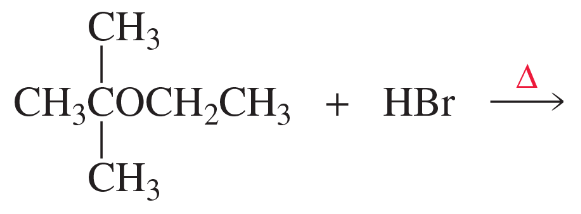
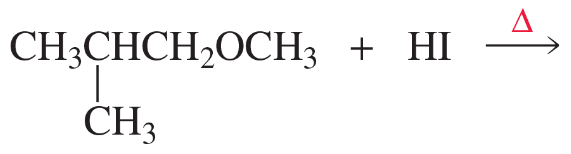
What is the major product(s) of each of the following reactions?
a.
b.

Verified step by step guidance
1
Step 1: Analyze the first reaction. The reactant is a ketone (CH3COCH2CH3) with a tertiary alkyl group attached to the carbonyl carbon. The reagent is HBr under heat (Δ). This suggests a halogenation reaction at the alpha-carbon of the ketone via an enol or enolate intermediate.
Step 2: In the first reaction, the acidic HBr protonates the carbonyl oxygen, increasing the electrophilicity of the carbonyl carbon. This facilitates the formation of an enol intermediate by tautomerization.
Step 3: The enol intermediate reacts with HBr, where the bromine atom adds to the alpha-carbon of the ketone. The major product will be the alpha-bromo ketone.
Step 4: Analyze the second reaction. The reactant is an ether (CH3CHCH2OCH3) with a secondary alkyl group attached to the oxygen. The reagent is HI under heat (Δ). This suggests a cleavage of the ether bond via an SN1 or SN2 mechanism.
Step 5: In the second reaction, HI protonates the ether oxygen, making it a better leaving group. The bond between the oxygen and the methyl group breaks, forming CH3I and a secondary alcohol (CH3CHCH2OH). The major products are methyl iodide and the alcohol.

Verified video answer for a similar problem:

This video solution was recommended by our tutors as helpful for the problem above.
Video duration:
4m
Was this helpful?

Key Concepts

Here are the essential concepts you must grasp in order to answer the question correctly.

Reaction Mechanisms

Understanding reaction mechanisms is crucial in organic chemistry as they describe the step-by-step process by which reactants transform into products. This includes identifying intermediates, transition states, and the movement of electrons. Familiarity with mechanisms helps predict the major products of reactions based on the stability of intermediates and the energy changes involved.
Recommended video:
Guided course
02:16
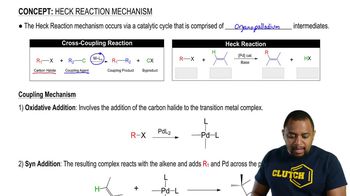
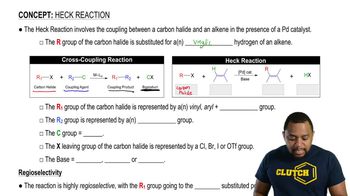
Heck Reaction Mechanism

Functional Groups

Functional groups are specific groups of atoms within molecules that are responsible for the characteristic chemical reactions of those molecules. Recognizing functional groups allows chemists to predict how different compounds will react under various conditions. This knowledge is essential for determining the major products of reactions, as different functional groups can lead to different pathways and outcomes.
Recommended video:
Guided course
02:36
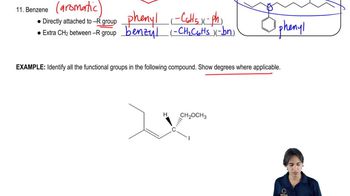
Identifying Functional Groups

Regioselectivity and Stereoselectivity

Regioselectivity refers to the preference of a chemical reaction to yield one structural isomer over others, while stereoselectivity involves the preference for one stereoisomer over another. These concepts are important for predicting the major products of reactions, especially in cases where multiple products are possible. Understanding these selectivities helps in rationalizing the outcome of reactions based on the stability of the resulting products.
Recommended video:
Guided course
05:09
Heck Reaction