Ch. 10 - Reactions of Alcohols, Ethers, Epoxides, Amines, and Sulfur-Containing Compounds
Bruice - Organic Chemistry 8th Edition
Bruice8th EditionOrganic ChemistryISBN: 9780135213711Not the one you use?Change textbook
Chapter 11, Problem 63d

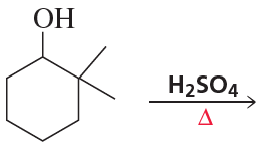
What is the major product(s) of each of the following reactions?
d. Chemical structure of a cyclohexanol with sulfuric acid catalyst indicating a dehydration reaction.

Verified step by step guidance
1
Step 1: Analyze the given reaction conditions. The presence of H2SO4 (sulfuric acid) and heat (Δ) suggests an acid-catalyzed dehydration reaction. This type of reaction typically involves the removal of a water molecule from an alcohol to form an alkene.
Step 2: Identify the alcohol group (-OH) in the given molecule. The hydroxyl group is attached to a tertiary carbon, which is highly favorable for dehydration due to the stability of the resulting carbocation intermediate.
Step 3: Predict the mechanism. The reaction proceeds via an E1 (unimolecular elimination) mechanism. First, the hydroxyl group is protonated by H2SO4, converting it into a better leaving group (water). This step leads to the formation of a tertiary carbocation.
Step 4: Consider carbocation rearrangement. Since the carbocation is already tertiary, no rearrangement is necessary. The next step involves elimination of a proton from a β-hydrogen (hydrogen on a carbon adjacent to the carbocation) to form the most stable alkene.
Step 5: Determine the major product. The major product will be the most substituted alkene, as it is more stable due to hyperconjugation and alkene stability rules (Zaitsev's rule). Analyze the structure to identify the β-hydrogens and predict the location of the double bond in the final product.

Verified video answer for a similar problem:

This video solution was recommended by our tutors as helpful for the problem above.
Video duration:
2m
Was this helpful?

Key Concepts

Here are the essential concepts you must grasp in order to answer the question correctly.

Dehydration Reaction

A dehydration reaction involves the removal of a water molecule from a compound, typically resulting in the formation of a double bond. In organic chemistry, this process often occurs with alcohols in the presence of an acid catalyst, leading to the formation of alkenes. The reaction is crucial for synthesizing more complex molecules and understanding reaction mechanisms.
Recommended video:
Guided course
01:23
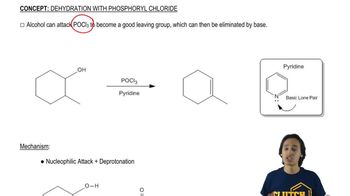
General Reaction of Dehydration with POCl3

Acid Catalysis

Acid catalysis involves the use of an acid to increase the rate of a chemical reaction. In the context of dehydration reactions, sulfuric acid (H2SO4) serves as a catalyst that protonates the alcohol, making it a better leaving group. This step is essential for facilitating the elimination of water and promoting the formation of the alkene product.
Recommended video:
2:50
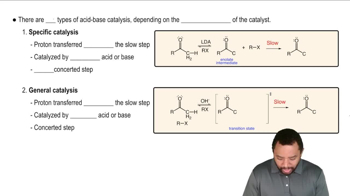
Acid-Base Catalysis Concept 3

Markovnikov's Rule

Markovnikov's Rule states that in the addition of HX to an alkene, the hydrogen atom will attach to the carbon with the greater number of hydrogen atoms already attached. This principle is important in predicting the major product of reactions involving alkenes, particularly when considering regioselectivity in dehydration reactions where carbocation stability plays a key role.
Recommended video:
Guided course
03:54
The 18 and 16 Electron Rule