Ch. 10 - Reactions of Alcohols, Ethers, Epoxides, Amines, and Sulfur-Containing Compounds
Bruice - Organic Chemistry 8th Edition
Bruice8th EditionOrganic ChemistryISBN: 9780135213711Not the one you use?Change textbook
Chapter 11, Problem 63g

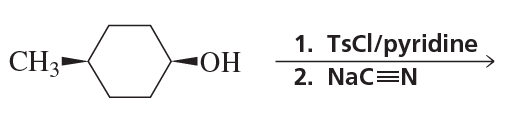
What is the major product(s) of each of the following reactions?
g. Chemical structure of a phenol with reaction steps using TsCl/pyridine and NaC≡N to indicate product formation.

Verified step by step guidance
1
Step 1: Analyze the starting material. The molecule is a cyclopentanol derivative with a hydroxyl (-OH) group and a methyl group attached to the ring. The hydroxyl group is in the axial position.
Step 2: Understand the role of TsCl/pyridine. Tosyl chloride (TsCl) reacts with the hydroxyl group in the presence of pyridine to convert it into a tosylate (-OTs) group. This step makes the hydroxyl group a better leaving group.
Step 3: Consider the stereochemistry of the tosylation reaction. The tosylate group will retain the stereochemistry of the original hydroxyl group, as this reaction does not invert the configuration.
Step 4: Examine the second reagent, NaCN. Sodium cyanide (NaCN) is a nucleophile that will perform an SN2 reaction, displacing the tosylate group. Since SN2 reactions proceed with inversion of configuration, the cyanide group (-CN) will attach to the carbon in the equatorial position.
Step 5: Predict the major product. The major product will be a cyclopentane ring with a cyanide group (-CN) in the equatorial position and a methyl group in the axial position, due to the stereochemical inversion during the SN2 reaction.

Verified video answer for a similar problem:

This video solution was recommended by our tutors as helpful for the problem above.
Video duration:
1m
Was this helpful?

Key Concepts

Here are the essential concepts you must grasp in order to answer the question correctly.

Alcohol Activation

In organic chemistry, alcohols can be converted into better leaving groups through activation. In this reaction, TsCl (tosyl chloride) is used in the presence of pyridine to convert the alcohol (-OH) into a tosylate, which is a more reactive species. This transformation facilitates subsequent nucleophilic substitution reactions.
Recommended video:
Guided course
01:01
How to name alcohols

Nucleophilic Substitution

Nucleophilic substitution is a fundamental reaction mechanism in organic chemistry where a nucleophile replaces a leaving group in a molecule. In this case, after the alcohol is converted to a tosylate, NaCN (sodium cyanide) acts as the nucleophile, attacking the carbon atom bonded to the tosylate and resulting in the formation of a nitrile (R-C≡N).
Recommended video:
Guided course
01:47
Nucleophiles and Electrophiles can react in Substitution Reactions.

Formation of Nitriles

Nitriles are organic compounds containing a cyano group (-C≡N) and are often formed through nucleophilic substitution reactions involving alkyl halides or activated alcohols. The reaction of the tosylate with NaCN leads to the formation of a nitrile, which can be useful in various synthetic applications, including the synthesis of amines and carboxylic acids.
Recommended video:
0:59
Review of Nitriles Concept 1