Back

Nucleophilic Acyl Substitution quiz

Control buttons has been changed to "navigation" mode.
1/15
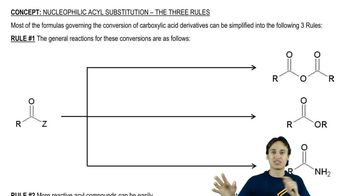
  • What are the three main products you can make from carboxylic acid derivatives in nucleophilic acyl substitution?

    You can make anhydrides, esters, or amides from carboxylic acid derivatives.
  • Which reagent is used to convert a carboxylic acid derivative into an anhydride?

    A carboxylate (O⁻R) is used to convert a carboxylic acid derivative into an anhydride.
  • What reagent is needed to form an ester from a carboxylic acid derivative?

    An alcohol is needed to form an ester from a carboxylic acid derivative.
  • Which reagent is required to synthesize an amide from a carboxylic acid derivative?

    An amine is required to synthesize an amide from a carboxylic acid derivative.
  • According to rule 2, what determines the reactivity of acyl compounds in nucleophilic acyl substitution?

    The strength of the leaving group determines the reactivity of acyl compounds.
  • List the order of reactivity for carboxylic acid derivatives from most to least reactive.

    The order is: acid chlorides > anhydrides > esters ≈ carboxylic acids > amides.
  • Why are acid chlorides considered the most reactive carboxylic acid derivative?

    Acid chlorides are most reactive because chloride is an excellent leaving group.
  • What is the general trend for converting acyl compounds based on reactivity?

    You can easily convert more reactive acyl compounds into less reactive ones, but not the reverse.
  • What is the process called when any carboxylic acid derivative is converted into a carboxylic acid using water?

    This process is called hydrolysis.
  • Can you convert an amide into a carboxylic acid using water and acid or base, even if it is energetically unfavorable?

    Yes, rule 3 states that any derivative can be converted into a carboxylic acid using water and acid or base.
  • Why are R and H not considered good leaving groups in nucleophilic acyl substitution?

    R and H are not good leaving groups because they cannot be easily displaced in nucleophilic acyl substitution.
  • What is the worst leaving group among carboxylic acid derivatives that still participates in nucleophilic acyl substitution?

    The amide (NH₂⁻) is the worst leaving group that still participates in nucleophilic acyl substitution.
  • What is the key factor that allows you to predict the outcome of nucleophilic acyl substitution reactions?

    Knowing the reactivity order and the appropriate reagent allows you to predict the reaction outcome.
  • What is the main rule to remember when converting carboxylic acid derivatives to other derivatives?

    You can convert more reactive derivatives to less reactive ones using the correct nucleophile.
  • What is the significance of hydrolysis in the context of carboxylic acid derivatives?

    Hydrolysis allows any carboxylic acid derivative to be converted into a carboxylic acid, regardless of energy favorability.