Back

Nucleophilic Acyl Substitution definitions

Control buttons has been changed to "navigation" mode.
1/13
  • Nucleophilic Acyl Substitution

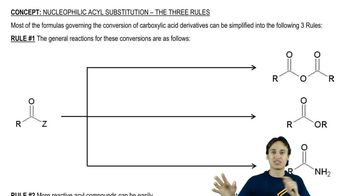
    A reaction converting carboxylic acid derivatives into other derivatives by replacing the Z group with a nucleophile.
  • Carboxylic Acid Derivative

    A compound structurally related to carboxylic acids, including acid chlorides, anhydrides, esters, and amides.
  • Acid Chloride

    The most reactive carboxylic acid derivative, featuring a chlorine atom as the leaving group.
  • Anhydride

    A carboxylic acid derivative formed by the condensation of two acids, less reactive than acid chlorides.
  • Ester

    A carboxylic acid derivative where the hydroxyl group is replaced by an alkoxy group, intermediate in reactivity.
  • Amide

    A carboxylic acid derivative with a nitrogen-containing group, the least reactive among common derivatives.
  • Carboxylate

    A resonance-stabilized anion derived from carboxylic acids, used to synthesize anhydrides.
  • Alcohol

    A nucleophile containing a hydroxyl group, used to convert carboxylic acid derivatives into esters.
  • Amine

    A nucleophile containing a nitrogen atom, used to convert carboxylic acid derivatives into amides.
  • Leaving Group

    An atom or group that departs with an electron pair during substitution, determining reactivity order.
  • Hydrolysis

    A process where water and acid or base convert any carboxylic acid derivative into a carboxylic acid.
  • Reactivity Order

    The ranking of carboxylic acid derivatives based on how easily they undergo substitution, dictated by leaving group ability.
  • Z Group

    The substituent attached to the acyl carbon in carboxylic acid derivatives, influencing reactivity and product.