Back

Lactones, Lactams and Cyclization Reactions quiz

Control buttons has been changed to "navigation" mode.
1/15
  • What is a lactone in organic chemistry?

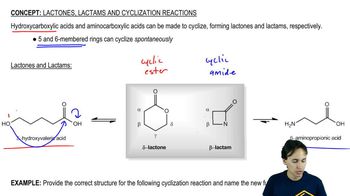
    A lactone is a cyclic ester formed by the cyclization of a hydroxycarboxylic acid.
  • How is a lactam formed?

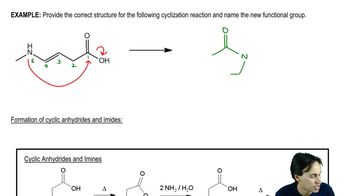
    A lactam is a cyclic amide formed by the cyclization of an amino carboxylic acid.
  • Why are 5- and 6-membered lactones and lactams most commonly formed?

    Because 5- and 6-membered rings are the most stable due to minimal ring strain.
  • What Greek letter is used to name a 6-membered lactone formed from delta-hydroxyvaleric acid?

    It is called a delta lactone, since the hydroxy group was on the delta carbon.
  • What is the significance of beta lactams in medicine?

    Beta lactams are important because they are found in antibiotics like penicillin and disrupt bacterial cell membranes.
  • What happens when a ring smaller than 5 members is formed during cyclization?

    Rings smaller than 5 members are much less stable and may not form spontaneously due to ring strain.
  • How can a cyclic anhydride be formed from a diacid like succinic acid?

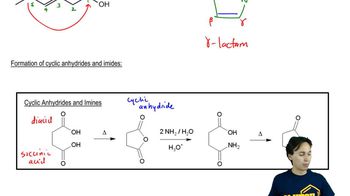
    By heating succinic acid, it can self-cyclize to form a cyclic anhydride.
  • What is the result of reacting a cyclic anhydride with ammonia (NH3)?

    Reacting a cyclic anhydride with ammonia produces a diamide, and further reaction with water can yield an amide and a carboxylic acid on the same chain.
  • What is an imide and how is it formed?

    An imide is a functional group similar to an anhydride but with a nitrogen atom in the ring, formed by heating a molecule containing both an amide and a carboxylic acid.
  • What is succinamide and why is it important in organic chemistry?

    Succinamide is an amide derived from succinic acid and is a precursor to N-bromo succinamide (NBS), a common reagent.
  • What does NBS stand for and what is its structure based on?

    NBS stands for N-bromo succinamide, which is succinamide with a bromine atom replacing a hydrogen on the nitrogen.
  • How are the positions for naming lactones and lactams determined?

    Positions are named using Greek letters starting from the carbon next to the carbonyl (alpha), counting along the chain to the substituent.
  • Why do sugars in the body often form lactones?

    Sugars can easily form stable 6-membered rings, leading to frequent lactone formation in biological systems.
  • What is the general mechanism for forming a lactone from a hydroxycarboxylic acid?

    The hydroxy group attacks the carbonyl carbon, forming a tetrahedral intermediate, and then the hydroxyl group is eliminated to form the ester ring.
  • What is the main difference between an anhydride and an imide?

    An anhydride has two carbonyl groups connected by an oxygen, while an imide has two carbonyls connected by a nitrogen atom.