Back

Lactones, Lactams and Cyclization Reactions definitions

Control buttons has been changed to "navigation" mode.
1/15
  • Lactone

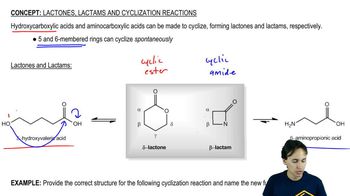
    A cyclic ester formed by cyclization of a hydroxycarboxylic acid, commonly found in 5- or 6-membered stable rings.
  • Lactam

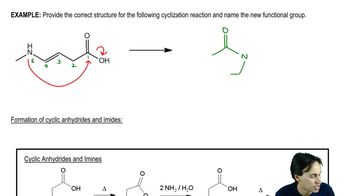
    A cyclic amide produced from amino carboxylic acids, with ring stability highest in 5- or 6-membered forms.
  • Cyclization

    A process where a chain molecule forms a ring, often leading to increased stability in 5- or 6-membered structures.
  • Hydroxycarboxylic Acid

    A molecule containing both a hydroxyl and a carboxylic acid group, serving as a precursor for lactone formation.
  • Amino Carboxylic Acid

    A compound with both an amino and a carboxylic acid group, enabling lactam ring formation upon cyclization.
  • Beta Lactam

    A four-membered cyclic amide, crucial in antibiotics like penicillin for disrupting bacterial cell walls.
  • Delta Lactone

    A six-membered cyclic ester formed when the hydroxyl group is on the delta carbon of a hydroxy acid.
  • Cyclic Anhydride

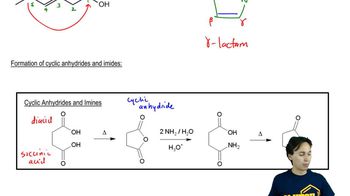
    A ring structure formed by self-cyclization of a diacid, especially under heat, featuring two acyl groups bonded to the same oxygen.
  • Succinic Acid

    A four-carbon diacid that can cyclize to form cyclic anhydrides and serves as a precursor for succinamide.
  • Amide

    A functional group derived from carboxylic acids and ammonia, featuring a carbonyl bonded to nitrogen.
  • Imide

    A functional group resembling an anhydride but with a nitrogen atom between two carbonyls, formed by heating an amide and carboxylic acid on the same chain.
  • Succinamide

    A compound derived from succinic acid, serving as the precursor to N-bromo succinamide, a common organic reagent.
  • N-Bromo Succinimide

    A reagent derived from succinamide, widely used for selective bromination in organic synthesis.
  • Tetrahedral Intermediate

    A transient structure formed during nucleophilic attack on a carbonyl, crucial in cyclization mechanisms.
  • Nucleophilic Acyl Substitution

    A reaction mechanism where a nucleophile replaces a leaving group on a carbonyl, central to lactone and lactam formation.