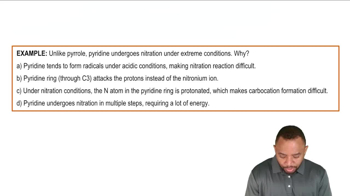
Why is pyridine less reactive than benzene in EAS reactions?
Pyridine is less reactive because its nitrogen atom is more electronegative, pulling electron density away from the ring and making it electron-deficient.
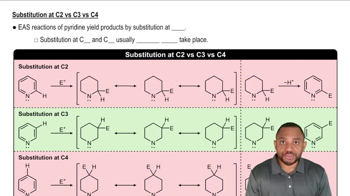
At which position does electrophilic aromatic substitution (EAS) most commonly occur in pyridine?
EAS most commonly occurs at the C3 position in pyridine.
Why is substitution at the C3 position of pyridine preferred over C2 or C4?
Substitution at C3 avoids placing a positive charge on the electronegative nitrogen atom, which would be unstable.
What happens to the nitrogen atom during EAS reactions in pyridine?
The nitrogen can become protonated or interact with Lewis acids, sometimes forming a positively charged nitrogen.
How do activating groups affect EAS reactions in pyridine?
Activating groups make EAS reactions more favorable by increasing electron density and directing substitution to ortho and para positions.
What is the effect of meta-directing groups on pyridine’s reactivity in EAS?
Meta-directing groups are deactivating and make EAS reactions even more difficult, often requiring higher temperatures.
Why are higher temperatures often required for EAS reactions on substituted pyridines?
Higher temperatures are needed because pyridine is less reactive, especially when deactivating groups are present.
What is the role of resonance in determining the preferred site of substitution in pyridine?
Resonance shows that substitution at C2 or C4 can place a positive charge on nitrogen, which is unfavorable, making C3 substitution preferred.
How does the presence of a methoxy group (OCH3) on pyridine influence EAS?
The methoxy group is an activating ortho-para director, but the nitrogen still prefers substitution at the C3 position.
What is the general rule for directing effects in polysubstituted pyridines?
The most activating group takes precedence in directing further substitution, but C3 is still preferred if available.
How does a carboxylic acid group affect EAS on pyridine?
A carboxylic acid is a meta-directing, deactivating group, making EAS even harder and requiring higher temperatures.
What is the typical temperature required for bromination of pyridine with an activating group?
Bromination with an activating group like OCH3 typically requires around 100°C.
What temperature might be needed for nitration of pyridine with a deactivating group?
Nitration with a deactivating group like a carboxylic acid may require temperatures as high as 300°C.
Why do EAS reactions on pyridine often avoid the para position?
The para position is occupied by nitrogen, so substitution there is not possible.
What is the main challenge in performing Friedel-Crafts reactions on pyridine?
Pyridine’s nitrogen can coordinate with Lewis acids, preventing typical Friedel-Crafts reactions from occurring.
 Back
Back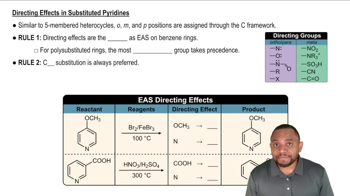
 3:22
3:22