Skip to main content
Organic Chemistry
My Course
Learn
Exam Prep
AI Tutor
Study Guides
Textbook Solutions
Flashcards
Explore
Try the app
My Course
Learn
Exam Prep
AI Tutor
Study Guides
Textbook Solutions
Flashcards
Explore
Try the app
Back
EAS Reactions of Pyridine definitions
You can tap to flip the card.
Pyridine
You can tap to flip the card.
👆
Pyridine
A six-membered aromatic heterocycle with a nitrogen atom, exhibiting electron deficiency compared to benzene.
Track progress
Control buttons has been changed to "navigation" mode.
1/15
Related flashcards
Related practice
Recommended videos
EAS Reactions of Pyridine quiz
EAS Reactions of Pyridine
15 Terms
EAS Reactions of Pyridine
27. Heterocycles
5 problems
Topic
SNAr Reactions of Pyridine
27. Heterocycles
5 problems
Topic
27. Heterocycles - Part 1 of 2
4 topics
12 problems
Chapter
27. Heterocycles - Part 2 of 2
4 topics
12 problems
Chapter
3:22
EAS Reactions of Pyridine Concept 3
3
views
1:18
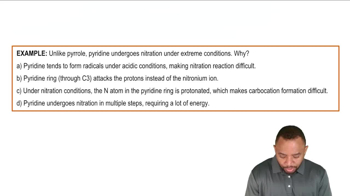
EAS Reactions of Pyridine Example 1
1
views
2:53
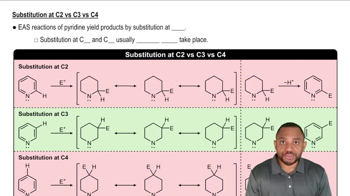
EAS Reactions of Pyridine Concept 2
3
views
Terms in this set (15)
Hide definitions
Pyridine
A six-membered aromatic heterocycle with a nitrogen atom, exhibiting electron deficiency compared to benzene.
Electrophilic Aromatic Substitution
A reaction where an aromatic hydrogen is replaced by an electrophile, often requiring harsher conditions for heterocycles.
Electron Deficiency
A state where electron density is withdrawn from a ring, making it less reactive toward electrophiles.
Nitrogen Atom
A heteroatom in the ring that increases electronegativity, pulling electron density and influencing reactivity.
Carbocation Intermediate
A positively charged species formed during substitution, whose stability determines the preferred site of reaction.
C3 Position
The site on the ring most favored for substitution, as it avoids placing a positive charge on nitrogen.
Activating Group
A substituent that increases the ring's reactivity, often directing new groups to ortho or para positions.
Meta Director
A substituent that decreases reactivity and directs incoming groups to the meta position relative to itself.
Ortho-Para Director
A substituent that increases reactivity and directs new groups to positions adjacent or opposite to itself.
Aromaticity
A property of cyclic molecules with delocalized electrons, restored after substitution by loss of a proton.
Resonance
The delocalization of electrons in a molecule, explaining the distribution of charges during reactions.
Deactivating Group
A substituent that reduces the ring's reactivity, often requiring higher temperatures for substitution.
Lewis Acid Catalyst
A compound, such as aluminum chloride, that can interact with nitrogen to facilitate or inhibit reactions.
Heterocycle
A ring structure containing at least one atom other than carbon, such as nitrogen in pyridine.
Substituted Pyridine
A pyridine ring bearing additional groups, whose nature and position influence further reactivity and selectivity.
 BackBack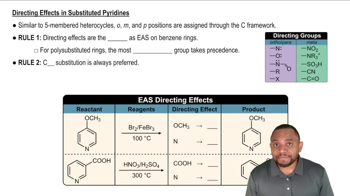
 3:22
3:22