Back

EAS:Retrosynthesis quiz

Control buttons has been changed to "navigation" mode.
1/15
  • What is the starting material in the example synthesis discussed in the lesson?

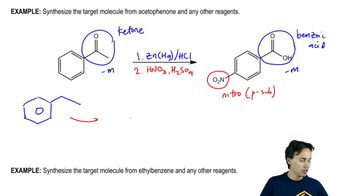
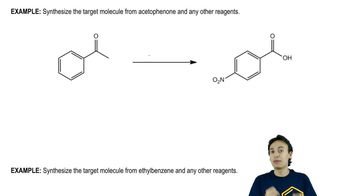
    The starting material is acetophenone.
  • What functional group transformation is required in the synthesis from acetophenone to the target molecule?

    A ketone group must be converted into a benzoic acid group.
  • Where must the nitro group be added in the target molecule according to the example?

    The nitro group must be added in the para position relative to the original substituent.
  • What type of director is a ketone group on a benzene ring?

    A ketone group is a meta director.
  • If you nitrate acetophenone directly, where will the nitro group be added?

    The nitro group will be added in the meta position.
  • Why can't you convert the ketone to benzoic acid before nitration in this synthesis?

    Because benzoic acid is also a meta director, leading to meta nitration instead of para.
  • What must you do to the ketone before nitration to achieve para substitution?

    You must convert the ketone into an ortho/para director before nitration.
  • What is the importance of reaction sequence in aromatic synthesis?

    The order of reactions determines the position of substituents due to directing effects.
  • What is a sequence group in the context of aromatic synthesis?

    A sequence group refers to a functional group that influences the position of subsequent substitutions on the aromatic ring.
  • Why is creativity important in proposing aromatic syntheses?

    Because you must apply your knowledge of reactions and reagents to devise a sequence that yields the desired product.
  • What is the directing effect of benzoic acid on a benzene ring?

    Benzoic acid is a meta director.
  • What is the main challenge when synthesizing a para-nitrobenzoic acid derivative from acetophenone?

    The challenge is to ensure the nitro group is introduced in the para position, which requires changing the directing effects before nitration.
  • What knowledge is essential for successful aromatic retrosynthesis?

    Understanding the directing effects of substituents and the correct sequence of functional group transformations is essential.
  • What happens if you nitrate a benzene ring with a meta-directing group?

    The incoming group will be directed to the meta position.
  • What is the first step you should consider when planning the synthesis of a para-substituted aromatic compound from a meta-directing starting material?

    You should first convert the meta-directing group into an ortho/para director before introducing the new substituent.