Back

EAS:Retrosynthesis definitions

Control buttons has been changed to "navigation" mode.
1/15
  • Aromatic Synthesis

    A process involving the construction of complex aromatic compounds from simpler benzene derivatives using strategic reaction sequences.
  • Benzene

    A six-membered aromatic ring serving as the foundational structure for many synthetic transformations in organic chemistry.
  • Acetophenone

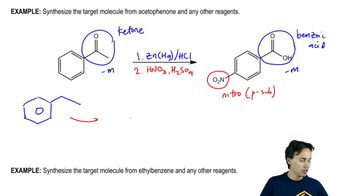
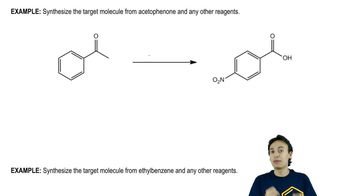
    A benzene ring bearing a methyl ketone group, acting as a starting material with meta-directing properties.
  • Benzoic Acid

    A benzene ring substituted with a carboxylic acid group, often formed by oxidizing a methyl or ketone group.
  • Nitro Group

    An electron-withdrawing substituent, typically introduced via nitration, influencing the position of further substitutions on an aromatic ring.
  • Para Substitution

    A pattern where a substituent is introduced at the position directly opposite another group on a benzene ring.
  • Meta Director

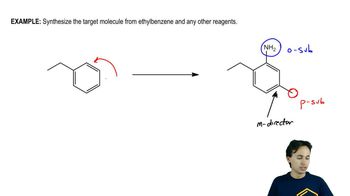
    A substituent that directs incoming electrophiles to the meta position relative to itself during aromatic substitution.
  • Ortho/Para Director

    A substituent that increases the likelihood of new groups attaching to the ortho or para positions on an aromatic ring.
  • Sequence Groups

    A strategic approach to ordering reactions so that substituents are introduced in the desired positions on an aromatic ring.
  • Nitration

    A reaction introducing a nitro group onto an aromatic ring, often requiring careful control of directing effects.
  • Transformation

    A chemical change converting one functional group into another, such as a ketone to a carboxylic acid.
  • Reagent

    A chemical substance used to induce a specific transformation or substitution in a synthetic sequence.
  • Target Molecule

    The final, desired compound in a synthetic sequence, often more complex than the starting material.
  • Substitution Pattern

    The arrangement of substituents on a benzene ring, determined by directing effects and reaction order.
  • Directing Effect

    The influence a substituent exerts on the position where new groups are introduced during aromatic substitution.