Back

EAS:Halogenation Mechanism quiz

Control buttons has been changed to "navigation" mode.
1/15
  • What is the role of the Lewis acid catalyst in EAS halogenation?

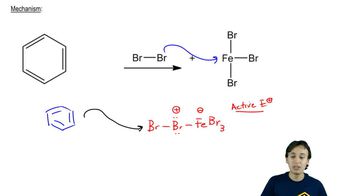
    The Lewis acid catalyst complexes with the diatomic halogen to form a highly electrophilic complex, enabling the reaction to proceed.
  • Which atom in the FeBr3-Br2 complex gains a negative charge during complexation?

    The iron atom (Fe) gains a negative charge after forming an extra bond with bromine.
  • Why does the bromine in the complex have a positive charge?

    The bromine has only 6 valence electrons due to 2 bonds and 2 lone pairs, making it electron-deficient and positively charged.
  • Which atom acts as the nucleophile in the EAS halogenation mechanism?

    Benzene acts as the nucleophile, attacking the electrophilic bromine complex.
  • Which bromine does benzene attack in the electrophilic complex?

    Benzene attacks the bromine adjacent to the positively charged bromine, not the one with the positive charge.
  • What intermediate is formed after benzene attacks the bromine complex?

    An arenium ion, also known as a sigma complex, is formed as the intermediate.
  • How is the arenium ion intermediate stabilized?

    The arenium ion is stabilized by resonance, with three possible resonance structures.
  • What is the slow step in the EAS halogenation mechanism?

    The slow step is the formation of the arenium ion (sigma complex) intermediate.
  • What acts as the nucleophile in the elimination step of EAS halogenation?

    FeBr4- (the negatively charged complex) acts as the nucleophile in the elimination step.
  • What happens during the elimination step of the mechanism?

    Electrons from the bromine are transferred to a hydrogen atom, leading to the elimination of HBr and restoration of aromaticity.
  • What is regenerated at the end of the EAS halogenation reaction?

    The Lewis acid catalyst (FeBr3) is regenerated at the end of the reaction.
  • What are the final products of EAS bromination of benzene?

    The final products are bromobenzene, HBr, and regenerated FeBr3.
  • Why can the resonance structure of the sigma complex be drawn in multiple ways?

    Because the positive charge can be delocalized to three different positions, allowing for three resonance structures.
  • Why is the Lewis acid catalyst considered a catalyst in this reaction?

    It is regenerated at the end of the reaction and is not consumed.
  • What is the overall transformation that occurs in EAS halogenation of benzene?

    A hydrogen atom on benzene is substituted with a bromine atom, producing HBr as a byproduct.