Back

EAS:Halogenation Mechanism definitions

Control buttons has been changed to "navigation" mode.
1/15
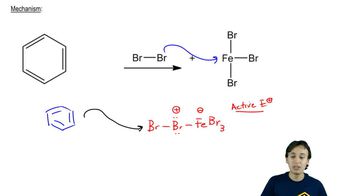
  • Lewis Acid Catalyst

    Electron pair acceptor that activates diatomic halogen, enabling electrophilic aromatic substitution to proceed.
  • Diatomic Halogen

    Molecule consisting of two identical halogen atoms, such as Br2, used as the halogen source in the reaction.
  • Electrophilic Complex

    Highly reactive species formed by halogen and catalyst, possessing a strong tendency to accept electrons.
  • Benzene

    Aromatic hydrocarbon ring acting as a nucleophile, attacking the activated halogen during substitution.
  • Nucleophile

    Electron-rich species that donates electrons to an electrophile, initiating the substitution process.
  • Arenium Ion

    Carbocation intermediate formed after benzene attacks the electrophile, temporarily disrupting aromaticity.
  • Sigma Complex

    Intermediate structure with a positive charge, stabilized by resonance, formed during aromatic substitution.
  • Resonance Structures

    Multiple valid Lewis structures that depict electron delocalization, stabilizing the reaction intermediate.
  • Elimination Step

    Reaction phase where a proton is removed, restoring aromaticity and completing the substitution.
  • FeBr4−

    Negatively charged iron-bromine complex acting as a nucleophile in the elimination step.
  • Aromaticity

    Special stability of benzene due to delocalized electrons, temporarily lost and then restored during the reaction.
  • HBr

    Byproduct formed when a hydrogen atom is replaced by bromine on the aromatic ring.
  • Catalyst Regeneration

    Process where the Lewis acid catalyst is reformed at the end of the reaction, allowing repeated use.
  • Formal Charge

    Calculated charge on an atom within a molecule, indicating electron gain or loss during complex formation.
  • Substitution

    Replacement of a hydrogen atom on benzene with a halogen atom, characteristic of this reaction mechanism.