Back

EAS:Friedel-Crafts Acylation Mechanism quiz

Control buttons has been changed to "navigation" mode.
1/15
  • What type of electrophile is formed in Friedel-Crafts acylation?

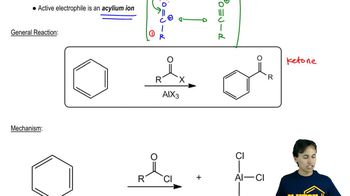
    An acylium ion is formed, which is resonance stabilized and has a full positive charge on the carbon.
  • What is the typical acyl halide used in Friedel-Crafts acylation?

    An acid chloride is typically used as the acyl halide in Friedel-Crafts acylation.
  • What catalyst is required for Friedel-Crafts acylation?

    A Lewis acid catalyst, such as AlCl3, is required for Friedel-Crafts acylation.
  • How is the acylium ion represented in resonance structures?

    The acylium ion can be drawn with a positive charge on the carbon or as a structure with a triple bond and positive charge on the oxygen.
  • Why is the acylium ion a good electrophile?

    It is a good electrophile because it has a full positive charge and is resonance stabilized.
  • What is the final product of Friedel-Crafts acylation on benzene?

    The final product is a ketone attached to the benzene ring.
  • Does Friedel-Crafts acylation involve carbocation intermediates?

    No, Friedel-Crafts acylation does not involve carbocation intermediates.
  • Why are rearrangements not a concern in Friedel-Crafts acylation?

    Rearrangements are not a concern because the acylium ion is resonance stabilized and does not form carbocations.
  • What happens when benzene reacts with the acylium ion?

    Benzene attacks the acylium ion, forming a sigma complex that eventually leads to the ketone product.
  • What role does AlCl4- play in the mechanism?

    AlCl4- acts as the conjugate base and is used in the beta elimination step to regenerate the Lewis acid catalyst.
  • What is the significance of the hydrogen in the sigma complex?

    The hydrogen is important for the elimination step, where it is removed to form the final ketone product.
  • What is regenerated at the end of the Friedel-Crafts acylation mechanism?

    The Lewis acid catalyst (such as AlCl3) is regenerated at the end of the mechanism.
  • What is a byproduct of the Friedel-Crafts acylation reaction?

    An acid, such as HCl, is formed as a byproduct.
  • Why is the first resonance structure of the acylium ion preferred for drawing the mechanism?

    It shows the positive charge on the carbon, which is the site attacked by benzene.
  • What is the main advantage of Friedel-Crafts acylation over alkylation regarding rearrangements?

    Friedel-Crafts acylation avoids rearrangements because it does not involve carbocation intermediates.