Back

EAS:Friedel-Crafts Acylation Mechanism definitions

Control buttons has been changed to "navigation" mode.
1/15
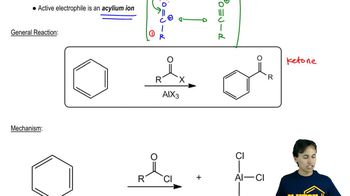
  • Friedel-Crafts Acylation

    A reaction introducing a ketone group onto an aromatic ring using an acyl halide and a Lewis acid catalyst.
  • Acyl Halide

    A compound containing a carbonyl group bonded to a halogen, commonly used to generate acylium ions.
  • Lewis Acid Catalyst

    A substance, such as AlCl3, that accepts electron pairs to activate acyl halides for electrophilic attack.
  • Acylium Ion

    A resonance-stabilized cation with a carbon doubly bonded to oxygen and carrying a positive charge, acting as a strong electrophile.
  • Resonance Stabilization

    Delocalization of electrons across multiple structures, enhancing the stability of reactive intermediates like acylium ions.
  • Electrophile

    A species with an electron deficiency, making it highly reactive toward electron-rich aromatic rings.
  • Sigma Complex

    An intermediate formed when an aromatic ring temporarily loses aromaticity during electrophilic substitution.
  • Ketone

    A functional group characterized by a carbonyl bonded to two carbons, formed on the aromatic ring after acylation.
  • Beta Elimination

    A step where a base removes a proton adjacent to a positively charged carbon, restoring aromaticity.
  • Conjugate Base

    The species, such as AlCl4-, that results from the Lewis acid after accepting a halide and participates in the elimination step.
  • Rearrangement

    A process absent in this mechanism, where carbocation intermediates shift positions, avoided due to resonance stabilization.
  • Aromatic Ring

    A planar, cyclic structure with delocalized pi electrons, serving as the substrate for acylation.
  • Acid Chloride

    A specific type of acyl halide containing a chlorine atom, commonly used in Friedel-Crafts acylation.
  • Carbocation Intermediate

    A reactive, positively charged carbon species not formed in this mechanism, preventing rearrangements.
  • Byproduct

    A secondary product, such as acid, formed alongside the main ketone product during the reaction.