Back

EAS:Any Carbocation Mechanism quiz

Control buttons has been changed to "navigation" mode.
1/15
  • What is the defining feature of the 'any carbocation' category of EAS mechanisms?

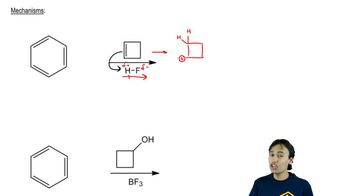
    They use carbocations as their active electrophiles.
  • Which two reagents are most commonly associated with carbocation-based EAS mechanisms?

    Hydrofluoric acid (HF) and boron trifluoride (BF3).
  • What must you be cautious of when dealing with carbocation intermediates in EAS mechanisms?

    You must watch out for carbocation shifts or rearrangements.
  • In the HF mechanism, what does the double bond attack to initiate the reaction?

    The double bond attacks the electrophilic hydrogen of HF.
  • Why is the hydrogen in HF considered electrophilic?

    Because the strong dipole in HF creates a partial positive charge on the hydrogen.
  • What is the typical nucleophile in a hydrohalogenation reaction, and how does this differ in EAS with HF?

    Typically, the halide ion (like F-) is the nucleophile, but in EAS with HF, benzene acts as the nucleophile and attacks the carbocation.
  • What is the main product when benzene reacts with a carbocation generated by HF?

    A substituted benzene with an alkyl group attached.
  • What byproduct is formed in the HF-catalyzed EAS mechanism?

    HF is regenerated as a byproduct, making it a true catalyst.
  • How does BF3 facilitate carbocation formation from alcohols?

    BF3 acts as a strong Lewis acid, accepting electron pairs from the oxygen, which helps break the C–O bond and generate a carbocation.
  • Is BF3 a catalyst or a promoter in the EAS reaction with alcohols, and why?

    BF3 is a promoter, not a catalyst, because it is consumed during the reaction.
  • What are the byproducts of the EAS reaction promoted by BF3 and alcohols?

    The byproducts are HF and BF2OH.
  • What happens if a carbocation intermediate can rearrange during these EAS mechanisms?

    The carbocation may undergo a shift to form a more stable carbocation before reacting with benzene.
  • What is the role of the F- ion in the elimination step of the HF-catalyzed EAS mechanism?

    F- acts as a base to remove a proton, completing the substitution and regenerating HF.
  • What is the final organic product in both HF and BF3 promoted EAS mechanisms?

    An alkylated benzene, where the benzene ring has a new alkyl group attached.
  • How is the EAS mechanism with BF3 and alcohols similar to Friedel-Crafts alkylation?

    Both involve carbocation intermediates and result in alkylated benzene products.