Back

EAS:Any Carbocation Mechanism definitions

Control buttons has been changed to "navigation" mode.
1/15
  • Carbocation

    A positively charged carbon species formed as an intermediate, highly reactive and prone to rearrangement before further reaction.
  • Electrophile

    A species with a partial or full positive charge that attracts nucleophiles, initiating addition to aromatic rings.
  • Nucleophile

    A species with electron density that seeks out positive centers, such as attacking carbocations in aromatic substitution.
  • Hydrofluoric Acid

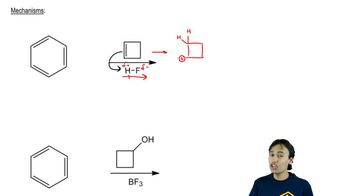
    A strong acid that acts as a catalyst, enabling double bonds to generate carbocations for aromatic substitution.
  • Boron Trifluoride

    A strong Lewis acid with an empty p orbital, promoting carbocation formation from alcohols but consumed during the reaction.
  • Lewis Acid

    A compound that accepts electron pairs, facilitating bond cleavage and carbocation generation in organic mechanisms.
  • Rearrangement

    A structural shift of a carbocation intermediate, often to a more stable position, before further reaction occurs.
  • Sigma Complex

    A resonance-stabilized intermediate formed after benzene attacks an electrophile, preceding restoration of aromaticity.
  • Friedel-Crafts Alkylation

    A reaction introducing an alkyl group onto benzene via a carbocation, often using a Lewis acid promoter or catalyst.
  • Hydrohalogenation

    A process where a hydrogen halide adds across a double bond, typically yielding alkyl halides in non-aromatic systems.
  • Promoter

    A substance, like BF3, that enables a reaction but is consumed, distinguishing it from a true catalyst.
  • Catalyst

    A substance that increases reaction rate without being consumed, such as HF in certain aromatic substitution mechanisms.
  • Byproduct

    A secondary compound formed during the main reaction, such as HF or BF2OH in carbocation-based aromatic substitutions.
  • Resonance Structure

    Alternative electron arrangements in intermediates, stabilizing charged species like the sigma complex during aromatic substitution.
  • Elimination

    A step where a leaving group departs, restoring aromaticity after nucleophilic attack in electrophilic aromatic substitution.