Back

Carboxylic Acid to Acid Chloride quiz

Control buttons has been changed to "navigation" mode.
1/15
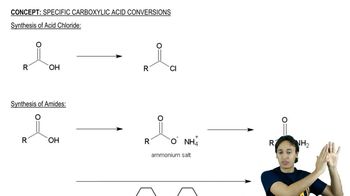
  • What is the most common reagent used to convert carboxylic acids to acid chlorides?

    SOCl2 is the most common reagent for this conversion.
  • Name two other reagents besides SOCl2 that can convert carboxylic acids to acid chlorides.

    PCl3 and PCl5 are also effective reagents for this transformation.
  • Why are acid chlorides considered highly reactive acyl compounds?

    Acid chlorides are highly reactive because they are at the top of the reactivity scale for acyl compounds.
  • What is the main synthetic advantage of converting carboxylic acids to acid chlorides?

    Acid chlorides can be easily transformed into other derivatives in high yields due to their reactivity.
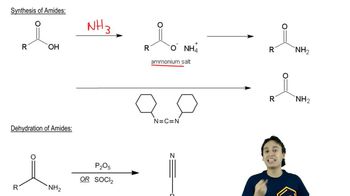
  • What is a common issue when converting carboxylic acids to amides using ammonia?

    The reaction often produces ammonium salts instead of amides, resulting in low yields.
  • How can the yield of amide formation from carboxylic acids and ammonia be improved?

    Using heat can dehydrate the ammonium salt to form amide, but yields are still not optimal.
  • What reagent can be used with NH3 to improve amide yields without heat?

    DCC (dicyclohexylcarbodiimide) is used as a dehydration agent to boost amide yields.
  • What is the role of DCC in amide synthesis?

    DCC dehydrates the reaction mixture, allowing amide formation without the need for high temperatures.
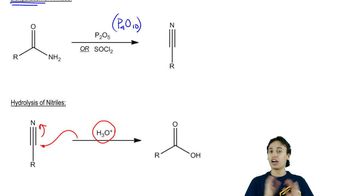
  • What is the primary method taught in this course for synthesizing nitriles?

    Nitriles are synthesized by dehydrating amides using reagents like P2O5 or SOCl2.
  • Which reagents are used to dehydrate amides to form nitriles?

    P2O5 (or P4O10) and SOCl2 are used for this dehydration reaction.
  • Why is dehydration of amides important for nitrile synthesis?

    It is the main method taught for making nitriles from carboxylic acid derivatives.
  • What must be synthesized first before making a nitrile from a carboxylic acid?

    The amide must be synthesized first, then dehydrated to form the nitrile.
  • How can nitriles be converted back to carboxylic acids?

    Nitriles are hydrolyzed to carboxylic acids, typically via acid-catalyzed reactions.
  • What intermediate is formed during the acid-catalyzed hydrolysis of nitriles?

    An imine derivative is formed before the final acid workup yields the carboxylic acid.
  • Is the detailed mechanism for nitrile hydrolysis emphasized in this course section?

    No, students are expected to memorize the reagents rather than the detailed mechanism.