Back

Carboxylic Acid to Acid Chloride definitions

Control buttons has been changed to "navigation" mode.
1/14
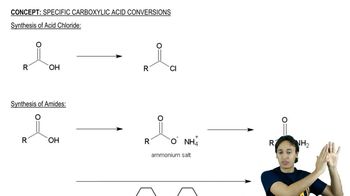
  • Carboxylic Acid

    A compound featuring a carbonyl and hydroxyl group on the same carbon, serving as a precursor for various acyl derivatives.
  • Acid Chloride

    A highly reactive acyl compound formed by replacing the hydroxyl group of a carboxylic acid with a chlorine atom.
  • SOCl2

    A reagent commonly used to introduce chlorine into molecules, especially effective for converting carboxylic acids to acid chlorides.
  • PCl3

    A phosphorus-based reagent rich in chlorine, useful for transforming carboxylic acids into acid chlorides.
  • PCl5

    A chlorinating agent containing five chlorine atoms, effective in synthesizing acid chlorides from carboxylic acids.
  • Amide

    A carboxylic acid derivative where the hydroxyl group is replaced by an amino group, less reactive than acid chlorides.
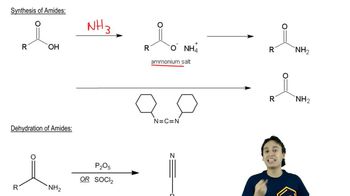
  • Ammonium Salt

    A byproduct formed when carboxylic acids react with ammonia, often requiring heat or dehydration agents to yield amides.
  • DCC

    A dehydration agent that enables high-yield amide formation from carboxylic acids and ammonia without the need for heat.
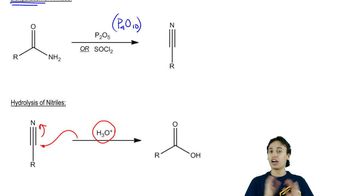
  • Nitrile

    A carboxylic acid derivative containing a cyano group, typically synthesized by dehydrating amides.
  • P2O5

    A strong dehydrating agent used to convert amides into nitriles by removing water.
  • Dehydration Reaction

    A process that removes water from a molecule, crucial for transforming amides into nitriles.
  • Hydrolysis

    A reaction involving water that breaks chemical bonds, such as converting nitriles back to carboxylic acids.
  • Imine Derivative

    An intermediate formed during the acid-catalyzed hydrolysis of nitriles, preceding the formation of carboxylic acids.
  • Acid Workup

    A step in a reaction sequence where acidic conditions are used to complete the transformation to the desired product.