Back

Advantages of Friedel-Crafts Acylation quiz

Control buttons has been changed to "navigation" mode.
1/15
  • Why is Friedel-Crafts acylation preferred over alkylation for aromatic substitution?

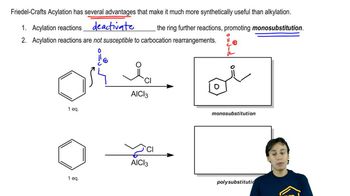
    Acylation deactivates the aromatic ring, favoring monosubstitution and preventing multiple substitutions, unlike alkylation.
  • What is the main advantage of acylation regarding carbocation rearrangements?

    Acylation does not undergo carbocation rearrangements because the acylium ion cannot resonate, maintaining the integrity of the added group.
  • What problem can occur during Friedel-Crafts alkylation with primary alkyl halides?

    Primary carbocations are unstable and can rearrange, leading to branched products instead of the desired straight-chain product.
  • How does acylation affect the reactivity of the benzene ring for further substitution?

    Acylation deactivates the benzene ring, making it less reactive and favoring only one substitution.
  • What is the typical product of Friedel-Crafts acylation of benzene with a three-carbon acyl chloride?

    The product is a ketone with a three-carbon chain attached to the benzene ring.
  • Why does Friedel-Crafts alkylation often result in polysubstitution?

    Alkylation activates the ring, making it more reactive and prone to multiple substitutions.
  • What is a common unintended product when attempting to add a three-carbon chain to benzene via alkylation?

    Isopropylbenzene is commonly formed due to carbocation rearrangement.
  • How can increasing the equivalents of benzene in an alkylation reaction affect the outcome?

    Increasing benzene promotes monosubstitution but does not prevent carbocation rearrangement.
  • What is the Clemmensen reduction used for in the context of Friedel-Crafts acylation?

    Clemmensen reduction removes the ketone group from the acylated product, converting it to an alkylbenzene.
  • What reagents are used in the Clemmensen reduction?

    Zinc amalgam (Zn(Hg)) and hydrochloric acid (HCl) are used.
  • What is the best method to synthesize n-propylbenzene from benzene?

    First perform Friedel-Crafts acylation to add a three-carbon chain, then use Clemmensen reduction to remove the ketone.
  • Why is the acylium ion less likely to rearrange than an alkyl carbocation?

    The acylium ion is stabilized by resonance and does not undergo rearrangement.
  • What does the 'n' in n-propylbenzene indicate?

    It indicates a straight-chain three-carbon group attached to benzene.
  • What is a key synthetic advantage of using acylation followed by reduction over direct alkylation?

    It ensures the addition of a straight-chain group without rearrangement or polysubstitution.
  • Why is Friedel-Crafts acylation considered more synthetically useful than alkylation?

    It provides better control over the product, avoiding rearrangements and multiple substitutions.