Back

Advantages of Friedel-Crafts Acylation definitions

Control buttons has been changed to "navigation" mode.
1/15
  • Friedel-Crafts Acylation

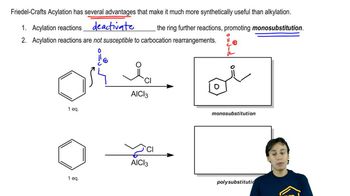
    A reaction introducing an acyl group to an aromatic ring, favoring single substitution and avoiding rearrangements.
  • Friedel-Crafts Alkylation

    A process adding an alkyl group to an aromatic ring, often leading to rearrangements and multiple substitutions.
  • Acylium Ion

    A reactive intermediate with a carbonyl and positive charge, resistant to rearrangement due to resonance stabilization.
  • Carbocation Rearrangement

    A process where an unstable carbocation shifts to a more stable form, often altering the intended product structure.
  • Monosubstitution

    A reaction outcome where only one substituent is added to the aromatic ring, minimizing further reactions.
  • Polysubstitution

    A scenario where multiple substituents are introduced to an aromatic ring, often leading to undesired products.
  • Clemmensen Reduction

    A method using zinc amalgam and HCl to remove a carbonyl group, converting ketones to hydrocarbons.
  • Zinc Mercury Amalgam

    A metallic reagent essential for reducing carbonyl groups to methylene groups in aromatic compounds.
  • Isopropylbenzene

    A branched aromatic compound formed from rearrangement during alkylation, not the desired straight-chain product.
  • n-Propylbenzene

    A straight-chain aromatic hydrocarbon, best synthesized via acylation followed by reduction to avoid branching.
  • Ketone Group

    A functional group with a carbonyl bonded to two carbons, introduced during acylation and removable by reduction.
  • Resonance Stabilization

    A phenomenon where electron delocalization prevents rearrangement, maintaining the structure of reactive intermediates.
  • Primary Carbocation

    An unstable intermediate with a positive charge on a primary carbon, prone to rearrangement during alkylation.
  • Hydride Shift

    A migration of a hydrogen atom with its electrons, causing carbocation rearrangement and altering product structure.
  • Aromatic Ring Deactivation

    A decrease in reactivity of an aromatic ring after substitution, reducing the likelihood of further reactions.