Back

Acid-Catalyzed Ester Hydrolysis quiz

Control buttons has been changed to "navigation" mode.
1/15
  • What is acid-catalyzed ester hydrolysis?

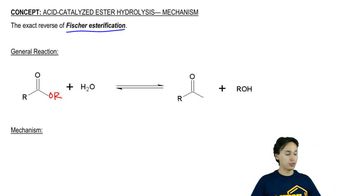
    It is the reverse of Fischer esterification, converting an ester back to a carboxylic acid using aqueous acid.
  • Which rule of nucleophilic acyl substitution (NAS) does acid-catalyzed ester hydrolysis follow?

    It follows rule number 3, which states that any carboxylic acid derivative can be converted to a carboxylic acid under acidic or basic conditions with water.
  • What is the first mechanistic step in acid-catalyzed ester hydrolysis?

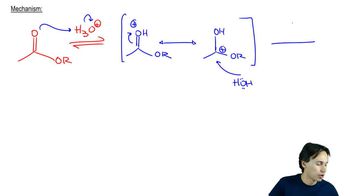
    The first step is protonation of the ester by H3O+, creating a positively charged intermediate.
  • What happens after the ester is protonated in the mechanism?

    Resonance stabilization occurs, making the carbonyl carbon more electrophilic and ready for nucleophilic attack.
  • Which molecule acts as the nucleophile in acid-catalyzed ester hydrolysis?

    Water acts as the nucleophile, attacking the protonated ester.
  • What intermediate is formed after water attacks the ester?

    An intermediate with OH, OR, and water groups attached to the central carbon is formed.
  • Why is a proton transfer performed to the OR group during the mechanism?

    The proton transfer to the OR group facilitates its removal as a leaving group.
  • What is the fate of the OR group after it is protonated?

    The OR group leaves as an alcohol after being protonated, resulting in a positively charged oxygen intermediate.
  • What is the final step in acid-catalyzed ester hydrolysis?

    The final step is deprotonation by water, regenerating the acid catalyst and yielding the carboxylic acid.
  • What are the two main products of acid-catalyzed ester hydrolysis?

    The products are a carboxylic acid and an alcohol.
  • How is the mechanism of acid-catalyzed ester hydrolysis related to Fischer esterification?

    It is the exact reverse of the Fischer esterification mechanism.
  • What role does H3O+ play in acid-catalyzed ester hydrolysis?

    H3O+ acts as the acid catalyst, protonating the ester and facilitating the reaction steps.
  • Why is resonance important in the mechanism of acid-catalyzed ester hydrolysis?

    Resonance increases the electrophilicity of the carbonyl carbon, making it more susceptible to nucleophilic attack.
  • What happens if the proton transfer occurs to the OH group instead of the OR group?

    If the proton transfer occurs to the OH group, the reaction would proceed in the forward direction (Fischer esterification) instead of hydrolysis.
  • What is regenerated at the end of the acid-catalyzed ester hydrolysis mechanism?

    The acid catalyst (H3O+) is regenerated at the end of the reaction.