Back

Acid-Catalyzed Ester Hydrolysis definitions

Control buttons has been changed to "navigation" mode.
1/15
  • Ester

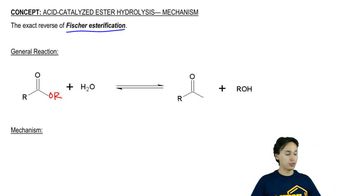
    A compound featuring a carbonyl group bonded to an oxygen atom, which is further connected to an alkyl or aryl group.
  • Carboxylic Acid

    A molecule containing a carbonyl and hydroxyl group on the same carbon, formed as the main product in this hydrolysis.
  • Fischer Esterification

    A process where a carboxylic acid and alcohol combine to form an ester and water, the reverse of hydrolysis.
  • Hydronium Ion

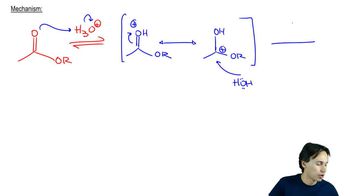
    A positively charged species, H3O+, acting as the acid catalyst in the hydrolysis mechanism.
  • Nucleophilic Attack

    A step where a molecule with a lone pair, such as water, donates electrons to an electron-deficient carbon.
  • Resonance Stabilization

    A phenomenon where electron delocalization distributes charge, stabilizing intermediates during the reaction.
  • Proton Transfer

    A movement of a hydrogen ion from one atom or group to another, facilitating the departure of a leaving group.
  • Leaving Group

    An atom or group, such as OR, that departs from the molecule during the reaction, often after protonation.
  • Intermediate

    A transient molecular structure formed between reactants and products, often carrying a charge or extra groups.
  • Equilibrium

    A state where the forward and reverse reactions occur at equal rates, indicated by double arrows in mechanisms.
  • Alcohol

    A byproduct of the hydrolysis, consisting of a hydroxyl group attached to an alkyl or aryl group.
  • Aqueous Acid

    A solution of acid in water, providing the acidic environment necessary for the hydrolysis to proceed.
  • NAS Rule

    A guideline stating that carboxylic acid derivatives can convert to carboxylic acids under acidic or basic conditions.
  • Deprotonation

    A step where a proton is removed from a molecule, often by water, to regenerate the acid catalyst.
  • Positively Charged Oxygen

    An oxygen atom bearing a formal positive charge, often resulting from protonation during the mechanism.